Tag: investors

Acquisition of flexible, low-carbon and renewable UK power generation from Iberdrola

RNS Number : 1562E
Drax Group PLC
THIS ANNOUNCEMENT CONTAINS INSIDE INFORMATION

Highlights

  • A unique portfolio of pumped storage, hydro and gas-fired generation assets
  • Compelling strategic rationale
    • Growing system support opportunity for the UK energy system
    • Significant expansion of Drax’s flexible, low-carbon and renewable generation model
    • Diversified generation capacity – multi-site, multi-technology
    • Opportunities in trading and operations
  • Strong financial investment case
    • High quality earnings
    • Expected returns significantly ahead of Weighted Average Cost of Capital (WACC)
    • Expected EBITDA(1) of £90-110 million in 2019
    • Debt facility agreed, net debt/EBITDA expected to be around 2x by the end of 2019
    • Supportive of credit rating and reduced risk profile for Drax
    • Strengthens ability to pay a growing and sustainable dividend

Will Gardiner, CEO, Drax Group

Commenting on today’s announcement Will Gardiner, Chief Executive Officer of Drax Group, said:

“I am excited by the opportunity to acquire this unique and complementary portfolio of flexible, low-carbon and renewable generation assets. It’s a critical time in the UK power sector. As the system transitions towards renewable technologies, the demand for flexible, secure energy sources is set to grow. We believe there is a compelling logic in our move to add further flexible sources of power to our offering, accelerating our strategic vision to deliver a lower-carbon, lower-cost energy future for the UK.

“This acquisition makes great financial and strategic sense, delivering material value to our shareholders through long-term earnings and attractive returns.

“We are combining our existing operational expertise with the specialist technical skills of our new colleagues and I am looking forward to what we can achieve together.”

A flexible, low-carbon and renewable portfolio

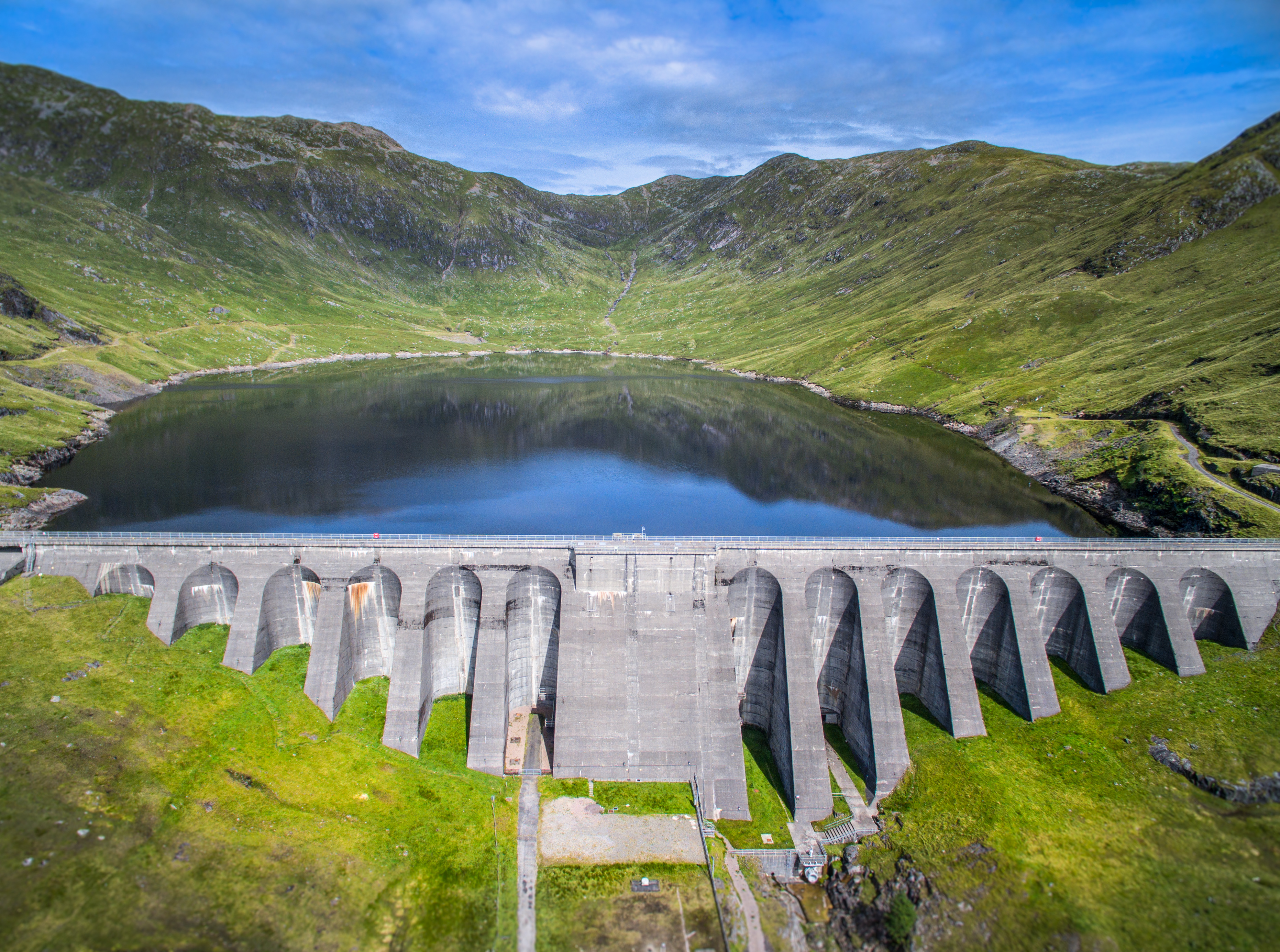
The Portfolio consists of Cruachan pumped storage hydro (440MW), run-of-river hydro locations at Galloway and Lanark (126MW), four CCGT(2) stations: Damhead Creek (805MW), Rye House (715MW), Shoreham (420MW) and Blackburn Mill (60MW), and a biomass-from-waste facility (Daldowie).

Attractive high quality earnings and returns

The Portfolio is expected, based on recent power and commodity prices, to generate EBITDA in a range of £90-110 million, from gross profits of £155 million to £175 million, of which around two thirds is expected to come from non-commodity market sources, including system support services, capacity payments, Daldowie and ROCs(3). Pumped storage and hydro activities represent a significant proportion of the earnings associated with the portfolio. Further information is set out in Appendix 2 of this Announcement.

Capital expenditure in 2019 is expected to be in the region of £30-35 million.

For the year ended 31 December 2017, the Portfolio generated EBITDA of £36 million(4). EBITDA in 2019 is expected to be higher due to incremental contracted capacity payments (c.£42 million), no availability restrictions (Cruachan’s access to the UK grid during 2017 was limited by network transformer works) (c.£8 million), a lower level of corporate cost charged to the portfolio (c.£9 million) and revenues from system support services and current power prices. Gross assets as at 31 December 2017 were £419 million(5).

The Acquisition represents an attractive opportunity to create significant value for shareholders and is expected to deliver returns significantly in excess of the Group’s WACC and to be highly accretive to underlying earnings in 2019.

The Acquisition strengthens the Group’s ability to pay a growing and sustainable dividend. Drax remains committed to its capital allocation policy and to its current £50 million share buy-back programme, with £32 million of shares purchased to date.

Financing the Acquisition

Drax has entered into a fully underwritten £725 million secured acquisition bridge facility agreement to finance the Acquisition. Assuming performance in line with current expectations, net debt to EBITDA is expected to fall to Drax’s long-term target of around 2x by the end of 2019.

Drax expects its credit rating agencies to view the Acquisition as contributing to a reduced risk profile for the Group and to reaffirm their ratings.

Conditions for completion

The Acquisition is expected to complete on 31 December 2018 and is conditional upon the approval of the Acquisition by Drax’s shareholders and clearance by UK Competition and Markets Authority (the “CMA”). A summary of the terms of the Acquisition agreement (the “Acquisition Agreement”) is set out in Appendix 1 to this announcement.

Drax trading and operational performance

Since publishing its half year results on 24 July 2018 Drax has commenced operation of a fourth biomass unit at Drax Power Station, which is performing in line with plan, and availability across biomass units has been good.
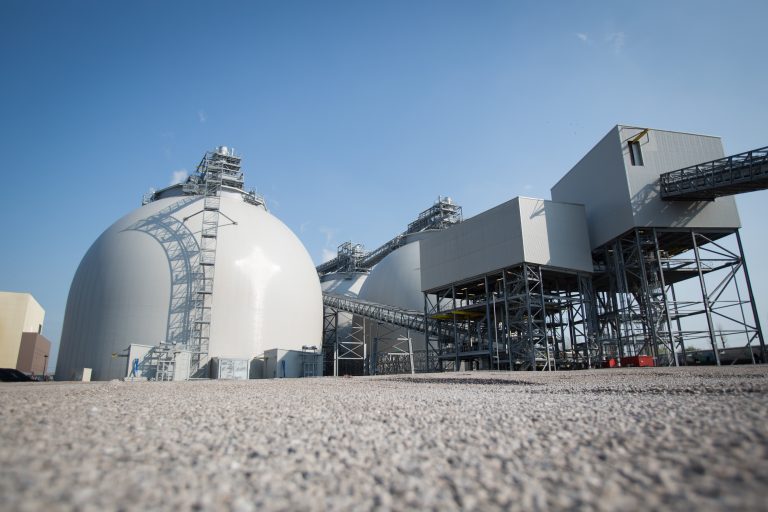
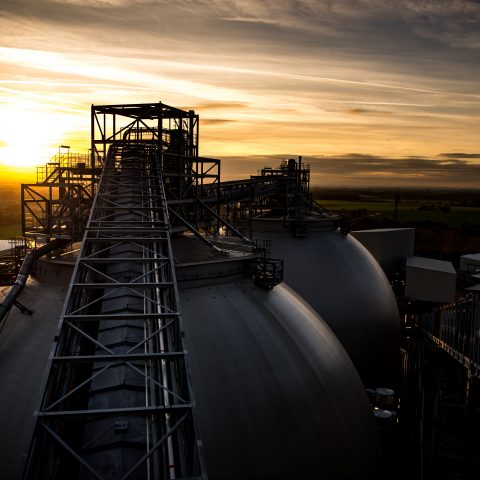
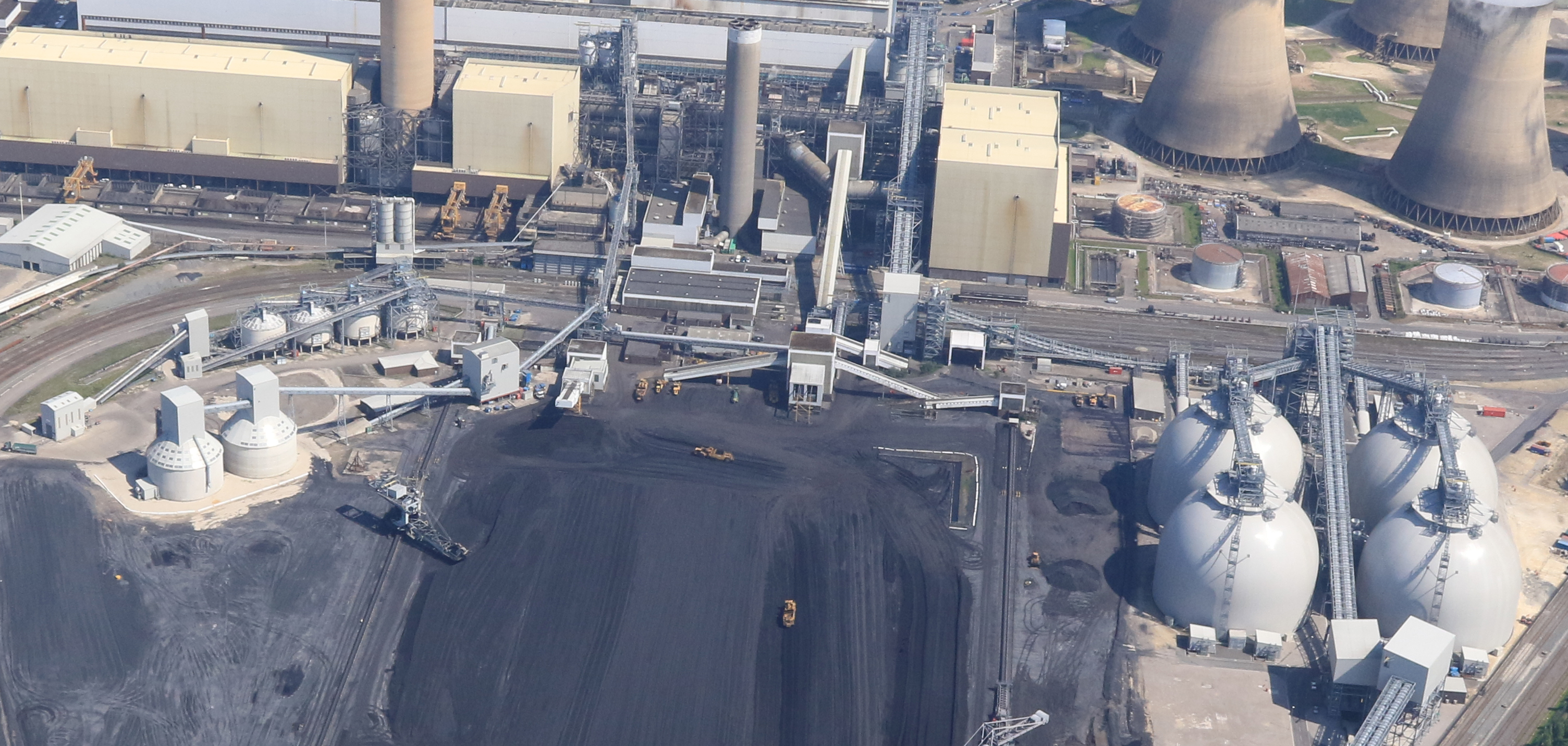
Biomass storage domes at Drax Power Station

Taking these factors into account, alongside a strong 2018 hedged position and assuming good operational availability for the remainder of the year, Drax’s EBITDA expectations for the full year remain unchanged, with net debt to EBITDA now expected to be around 1.5x for the full year, excluding the impact of the Acquisition.

Biomass generation is now fully contracted for 2019.

Contracted power sales at 30 September 2018

201820192020
Power sales (TWh) comprising:18.611.55.7
TWh including expected CfD sales18.615.611.2
– Fixed price power sales (TWh) 18.611.05.1
At an average achieved price (per MWh)at £46.8at £50.4at £48.3
– Gas hedges (TWh)-0.50.6
At an achieved price per therm-43.5p47.4p

Drax intends to hedge up to 1TWh of the commodity exposures in the Portfolio ahead of completion in line with the Group’s existing hedging strategy.

Other matters

In light of the Acquisition and the expected timing of the general meeting to approve it, Drax will postpone the planned Capital Markets Day on 13 November 2018.

Drax expects to announce its full year results for the year ending 31 December 2018 on 26 February 2019.

Enquiries:
Drax Investor Relations: Mark Strafford
+44 (0) 1757 612 491
+44 (0) 7730 763949

Media:
Drax External Communications:
Matt Willey
+44 (0) 7711 376087

Ali Lewis
+44 (0) 77126 70888

J.P. Morgan Cazenove (Financial Adviser and Joint Corporate Broker):
+44 (0) 207 742 6000
Robert Constant
Jeanette Smits van Oyen
Carsten Woehrn

Royal Bank of Canada (Joint Corporate Broker):
+44 (0) 20 7653 4000
James Agnew
Jonathan Hardy


Acquisition presentation meeting and webcast arrangements

Management will host a presentation for analysts and media at 9:00am (UK Time), Tuesday 16 October 2018, at FTI Consulting, 200 Aldersgate, Aldersgate Street, London EC1A 4HD.

Would anyone wishing to attend please confirm by e-mailing [email protected] or calling Christopher Laing at FTI Consulting on +44 (0) 20 3727 1355 / 07809 234 126.

The meeting can also be accessed remotely via a live webcast, as detailed below. After the meeting, the webcast will be made available and access details of this recording are also set out below.

A copy of the presentation will be made available from 9am (UK time) on Tuesday 16 October 2018 for download at: www.drax.com>>investors>>results-reports-agm>> #investor-relations-presentations or use the link below.

Event Title:Drax Group plc: Acquisition of flexible, low-carbon and renewable UK power generation from Iberdrola
Event Date:Tuesday 16 October 2018
Event Time9:00am (UK time)
Webcast Live Event Linkhttps://www.drax.com/investors/16-oct-2018-webcast
020 3059 5868 (UK)
+44 20 3059 5868 (from all other locations)
Start Date:Tuesday 16 October 2018
Delete Date:Monday 14 October 2019
Archive Link:https://www.drax.com/investors/16-oct-2018-webcast

For further information please contact Christopher Laing on +44 (0) 20 3727 1355 / 07809 234 126.

Website: www.drax.com


Acquisition of the Portfolio from Iberdrola

Drax Smart Generation Holdco Limited (“Drax Smart Generation”), a wholly owned subsidiary of Drax, has entered into the Acquisition Agreement with Scottish Power Generation Holdings Limited (the “Seller”), a wholly-owned subsidiary of Iberdrola S.A., for the acquisition of ScottishPower Generation Limited (“SPGEN”), for £702 million in cash.

Strong asset base

The Portfolio principally consists of 2.6GW of assets which are highly complementary to Drax’s existing generation portfolio and play an important role in the UK energy system. The assets include:

Cruachan Pumped Storage Hydro

440MW of large-scale storage and flexible low-carbon generation situated in Argyll and Bute, Scotland.

Cruachan provides a wide range of system support services to the UK energy market, in addition to providing merchant power generation. Cruachan has £35 million of contracted capacity payments for the period 2019 to 2022.

Cruachan, which provides over 35% of the UK’s pumped storage by volume, can provide long-duration storage with the ability to achieve full load in 30 seconds, which it can maintain for over 16 hours, making it a strategically important asset remunerated by a broad range of non-commodity based revenues.


Galloway and Lanark Run-of-River Hydro

126MW of stable and reliable renewable generation situated in South-west Scotland.

Both locations benefit from index-linked ROC revenues extending to 2027 and Galloway, in addition to renewable power generation, operates a reservoir and dam system providing storage capabilities and opportunities for peaking generation and system support services. It also has £4 million of contracted capacity payments for the period 2019 to 2022.


Combined Cycle Gas Generation (CCGT)

1,940MW of capacity at Damhead Creek (805MW), Rye House (715MW) and Shoreham (420MW) all strategically located in South-east England.

These assets provide baseload and/or peak power generation in addition to other system support services and benefit from attractive grid access income associated with their location. The three plants have contracted capacity payments of £127 million for the period 2019 to 2022.

Damhead Creek also benefits from an attractive option for the development of a second CCGT asset, Damhead Creek II, which provides additional gas generation optionality alongside Drax’s existing coal-to-gas repowering and OCGT(6) projects. All options could be developed subject to an appropriate level of support. Damhead Creek II is eligible for the 2019 capacity market auction along with two of Drax’s existing OCGT projects.

Other smaller sites

The portfolio also includes a small CCGT in Blackburn (60MW) and a 50K tonne biomass-from-waste facility in Daldowie, which benefits from a firm offtake contract agreement with Scottish Water until 2026.

Benefits of the Acquisition

A leading provider of flexible, low-carbon and renewable generation in the UK

The UK has a target to reduce carbon emissions by 80% by 2050. The transition to a low-carbon economy requires decarbonisation of heating, transport and generation. This will in turn require additional low-carbon sources of generation to be developed in the UK. As much as 85%(7) of future generation could come from renewables – predominantly wind and solar. This will lead, at times, to high levels of power price volatility and increasing demand for system support services. Managing an energy system with these characteristics will only be possible if it is supported by the right mix of flexible assets to manage volatility, balance the system and provide crucial non-generation services which a stable energy system requires.

The Acquisition is closely aligned with this structural need and the operation of Drax’s existing biomass and gas options which provide the flexibility required to enable higher levels of intermittent renewable generation.

The Acquisition is in line with these system needs and when combined with Drax’s existing flexible, biomass generation and gas options offers the Group increased exposure to the growing need for system support and power price volatility.

Increased earnings potential aligned with generation strategy and UK energy needs

The Acquisition is closely aligned with this structural need and the operation of Drax’s existing biomass and gas options which provide the flexibility required to enable higher levels of intermittent renewable generation.

The Acquisition is in line with these system needs and when combined with Drax’s existing flexible, biomass generation and gas options offers the Group increased exposure to the growing need for system support and power price volatility.

High quality earnings

Two thirds of the gross profits of the Portfolio is expected to come from non-commodity market sources, including system support services, capacity payments, Daldowie and ROCs, in addition to power generation activities. Due to the expected growing demand for these assets and the contract-based nature of many of these services Drax expects to improve long-term earnings visibility through structured non-commodity earnings streams, whilst retaining significant opportunity to benefit from power price volatility.

When combined with renewable earnings and system support from existing biomass generation, the Acquisition is expected to lead to an increase in the quality of earnings.

Diversified generation and portfolio benefits
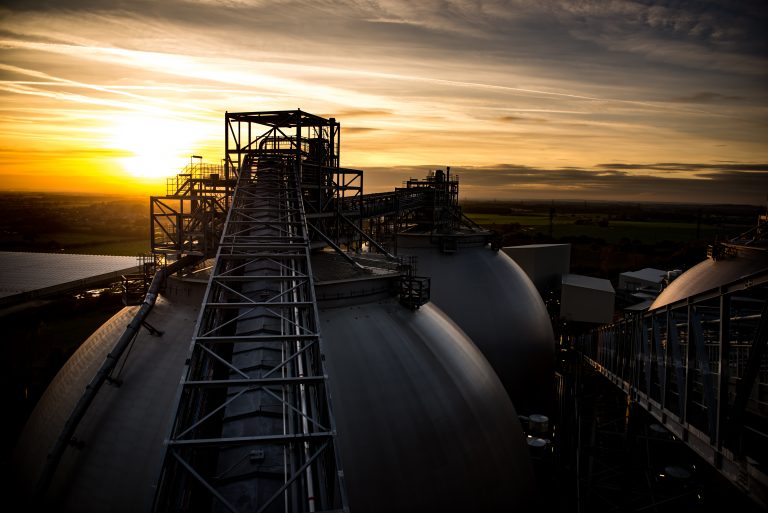
Wood pellet storage domes at Drax Power Station, Selby, North Yorkshire

The Acquisition accelerates Drax’s development from a single-site generation business into a multi-site, multi-technology operator.

With the acquisition of this portfolio, a fall in gas prices could be mitigated by an increase in gas-fired generation reflecting the relative dispatch economics of the different technologies.

Drax expects to benefit from the management of generation across a broader asset base, leveraging the Group’s expertise in the operation, trading and optimisation of large rotating mass generation.

Drax believes that the team operating the Portfolio has a strong engineering culture which is closely aligned with the Drax model and will enhance the Group’s strong capabilities across engineering disciplines.

Around 260 operational roles will transfer to Drax as part of the Acquisition, complementing and reinforcing Drax’s existing engineering and operational capabilities.

Financing and capital structure

Drax has entered into a fully underwritten £725 million secured acquisition bridge facility to finance the Acquisition, with a term of 12 months from the first date of utilisation of the facility (with a seven-month extension option) and interest payable at a rate of LIBOR plus the applicable margin (the “Acquisition Facility Agreement”). The facility is competitively priced and below Drax’s current cost of debt.

Drax will consider its options for its long-term financing strategy in 2019.

Assuming performance in line with current expectations, net debt to EBITDA is expected to return to Drax’s long-term target of around 2x by the end of 2019.

Drax expects credit rating agencies to view the Acquisition as supportive of the rating and contributing to a reduced risk profile for the Group.

Process and integration plan

Drax is progressing a detailed integration plan to combine the Acquisition as part of the existing Power Generation business.

The transaction is subject to shareholder approval. A combined Shareholder Circular and notice of General Meeting will be posted as soon as practicable.

The transaction is expected to complete on 31 December 2018.

Notes:

(1)    EBITDA is defined as earnings before interest, tax, depreciation, amortisation and material one-off items that do not reflect the underlying trading performance of the business. 2019 EBITDA is stated before any allocation of Group overheads.
(2)    Combined Cycle Gas Turbine.
(3)    Renewable Obligation Certificates.
(4)    2017 EBITDA is unaudited and based on the audited financial statements of Scottish Power Generation Limited and SMW Limited, adjusted to exclude results of assets that do not form part of the Portfolio and restated in accordance with Drax accounting policies.
(5)    On an unaudited historic cost basis, inclusive of an historic write down and other changes arising from the application of Drax’s accounting policies, and incorporating intercompany debtors which will be replaced by Drax going forward.
(6)    Open Cycle Gas Turbines.
(7)    Intergovernmental Panel on Climate Change. In a 1.5c pathway renewables are projected to be 70-85% of global electricity in 2050.

IMPORTANT NOTICE

The contents of this announcement have been prepared by and are the sole responsibility of Drax Group plc (the “Company”).

J.P. Morgan Limited (which conducts its UK investment banking business as J.P. Morgan Cazenove) (“J.P. Morgan Cazenove”) and RBC Europe Limited (“RBC”), which are both authorised by the Prudential Regulation Authority (the “PRA”) and regulated in the United Kingdom by the FCA and the PRA, are each acting exclusively for the Company and for no one else in connection with the Acquisition, the content of this announcement and other matters described in this announcement and will not regard any other person as their respective clients in relation to the Acquisition, the content of this announcement and other matters described in this announcement and will not be responsible to anyone other than the Company for providing the protections afforded to their respective clients nor for providing advice to any other person in relation to the Acquisition, the content of this announcement or any other matters referred to in this announcement.

J.P. Morgan Cazenove, RBC and their respective affiliates do not accept any responsibility or liability whatsoever and make no representations or warranties, express or implied, in relation to the contents of this announcement, including its accuracy, fairness, sufficient, completeness or verification or for any other statement made or purported to be made by it, or on its behalf, in connection with the Acquisition and nothing in this announcement is, or shall be relied upon as, a promise or representation in this respect, whether as to the past or the future. Each of J.P. Morgan Cazenove, RBC and their respective affiliates accordingly disclaims to the fullest extent permitted by law all and any responsibility and liability whether arising in tort, contract or otherwise which it might otherwise be found to have in respect of this announcement or any such statement.

Certain statements in this announcement may be forward-looking. Any forward-looking statements reflect the Company’s current view with respect to future events and are subject to risks relating to future events and other risks, uncertainties and assumptions relating to the Company and its group’s, the Portfolio’s and/or, following completion, the enlarged group’s business, results of operations, financial position, liquidity, prospects, growth, strategies, integration of the business organisations and achievement of anticipated combination benefits in a timely manner. Forward-looking statements speak only as of the date they are made. Although the Company believes that the expectations reflected in these forward looking statements are reasonable, it can give no assurance or guarantee that these expectations will prove to have been correct. Because these statements involve risks and uncertainties, actual results may differ materially from those expressed or implied by these forward looking statements.

Each of the Company, J.P. Morgan Cazenove, RBC and their respective affiliates expressly disclaim any obligation or undertaking to supplement, amend, update, review or revise any of the forward looking statements made herein, except as required by law.

You are advised to read this announcement and any circular (if and when published) in their entirety for a further discussion of the factors that could affect the Company and its group, the Portfolio and/or, following completion, the enlarged group’s future performance. In light of these risks, uncertainties and assumptions, the events described in the forward-looking statements in this announcement may not occur.

Neither the content of the Company’s website (or any other website) nor any website accessible by hyperlinks on the Company’s website (or any other website) is incorporated in, or forms part of, this announcement.


Appendix 1

Principal Terms of the Acquisition

The following is a summary of the principal terms of the Acquisition Agreement.

  1. Acquisition Agreement

Parties and consideration

The Acquisition Agreement was entered into on 16 October 2018 between Drax Smart Generation and the Seller. Pursuant to the Acquisition Agreement, the Seller has agreed to sell, and Drax Smart Generation has agreed to acquire, the whole of the issued share capital of SPGEN for £702 million, subject to certain customary adjustments in respect of cash, debt and working capital.

Drax Group Holdings Limited has agreed to guarantee the payment obligations of Drax Smart Generation under the Acquisition Agreement. Scottish Power UK plc has agreed to guarantee the payment obligations of the Seller under the Acquisition Agreement.

Conditions to Completion

The Acquisition is conditional on:

  • the approval of the Acquisition by Drax shareholders, which is required as the Acquisition constitutes a Class 1 transaction under the Listing Rules (the “Shareholder Approval Condition”); and
  • the CMA having indicated that it has no further questions at that stage in response to pre-Completion engagement by Drax or the CMA having provided a decision that the Acquisition will not be subject to a reference under the UK merger control regime.

Completion is currently expected to occur on 31 December 2018 assuming that the conditions are satisfied by that date.

Termination for material reduction in available generation capacity

Drax Smart Generation has the right to terminate the Acquisition Agreement upon the occurrence of a material reduction in available generation capacity at any of the Cruachan, Galloway and Lanark or Damhead Creek facilities which subsists, or is reasonably likely to subsist, for a continuous period of three months. The right of Drax Smart Generation to terminate in these circumstances is subject to the Seller’s right to defer Completion if the relevant material reduction in available generation capacity can be resolved by end of the month following the anticipated date of Completion.

Break fee

A break fee of £14.6 million (equal to 1% of Drax’s market capitalisation at close of business on the day before announcement) is payable if the Shareholder Approval Condition is not met, save where this is as a result of a material reduction in available generation capacity as described above.

Pre-completion covenants

The Seller has given certain customary covenants in relation to the period between signing of the Acquisition Agreement and completion, including to carry on the SPGEN business in the ordinary and usual course.  The Seller will carry out certain reorganisation steps prior to completion.

Pension liabilities

Drax Smart Generation has agreed to assume the accrued defined benefit pension liabilities associated with the employees of the SPGEN group as at the date of signing the Acquisition Agreement. Following Completion, the SPGEN group will continue to participate in the Seller’s group defined benefit pension scheme, known as the ScottishPower Pension Scheme (“SPPS”) for an interim period of 12 months unless agreed otherwise (the “Interim Period”) while a new pension scheme is set up by the SPGEN group for the benefit of its employees (the “New Scheme”).

At the end of the Interim Period, the SPPS trustees will be requested to transfer from the SPPS to the New Scheme an amount of liabilities (and corresponding share of assets) agreed between the Seller and Drax Smart Generation (or failing agreement, an amount determined by an independent actuary) in respect of the past service liabilities relating to the SPGEN group employees.  If the amount of assets transferred to the New Scheme does not match the amount agreed (or independently determined), there will be a true-up between the Seller and Drax Smart Generation.

If the SPPS trustees do not make any transfer to the New Scheme within the period of 18 months following the Interim Period (unless this was caused by a breach of the Acquisition Agreement by the Seller), Drax Smart Generation has agreed to pay £16 million (plus base rate interest) to the Seller as compensation for the SPPS liabilities not taken on by the New Scheme.

Seller’s warranties, indemnities and tax covenant

The Seller has provided customary warranties in the Acquisition Agreement.  The Seller also has provided Drax Smart Generation with indemnities in respect of certain specific matters, including for any losses associated with the reorganisation referred to above.  A customary tax covenant is also provided in the Acquisition Agreement.

  1. Transitional Services Agreement

The Seller and SPGEN will enter into a transitional services agreement effective at Completion. The specific nature, terms and charges relating to the services to be provided will be agreed between the Seller and SPGEN prior to Completion. The Seller will also provide assistance in relation to the extraction and separation of the SPGEN group from the systems of the Seller and integration of the SPGEN group onto the systems of the Drax Group.


Appendix 2

Profit Forecast

Profit forecast for the Portfolio for the year ending 31 December 2019 including bases and assumptions.

The Portfolio is expected, based on recent power and commodity prices, to generate EBITDA in a range of £90-110 million (“Profit Forecast”), and gross profits of £155 million to £175 million, of which around two thirds is expected to come from non-commodity market sources, including system support services, capacity payments, Daldowie and ROCs. Pumped storage and hydro activities represent a significant proportion of the earnings associated with the portfolio.

For the purpose of the Profit Forecast, EBITDA is stated before any allocation of Group overheads (as these will be an allocation of the existing Drax Group cost base which is not expected to increase as a result of the acquisition of the Portfolio).

Basis of preparation

The Profit Forecast has been compiled on the basis of the assumptions stated below, and on the basis of the accounting policies of the Drax Group adopted in its financial statements for the year ended 31 December 2017. Subsequent accounting policy changes include the application of IFRS15 and IFRS9 which are not initially expected to change the EBITDA results of the Portfolio. It also does not reflect the impact of IFRS16 which would apply in respect of the 2019 Annual Report and Accounts.

The Profit Forecast has been prepared with reference to:

  • Unaudited 2017 financial statements based on the audited financial statements of Scottish Power Generation Limited and SMW Limited, adjusted to exclude results of assets that do not form part of the Portfolio and restated in accordance with Drax accounting policies
  • The audited financial statements of the entities forming the Portfolio for the year ending 31 December 2017
  • The unaudited management accounts of the Portfolio for the nine months ending 30 September 2018
  • And on the basis of the projected financial performance of the Portfolio for the year ending 31 December 2019

The Profit Forecast is a best estimate of the EBITDA that the Portfolio will generate for a future period of a year in respect of assets and operations that are not yet under the control of Drax. Accordingly the degree of uncertainty relating to the assumptions underpinning the Profit Forecast is inherently greater than would be the case for a profit forecast based on assets and operation under the control of Drax and/or which covered a shorter future period. The Profit Forecast has been prepared as at today and will be updated in the shareholder circular.

The forecast cost base reflects the expectations of the Drax Directors of the operating regime of the Portfolio under Drax’s ownership and the central support it will require.

Principal assumptions

The Profit Forecast has been prepared on the basis of the following principal assumptions:

Assumptions within management’s control

  1. There is no change in the composition of the Portfolio.
  2. There is no material change to the manner in which these assets are operated.
  3. There are no material changes to the existing running costs / operating costs of the Portfolio.
  4. There will be no material restrictions on running each of the assets in the Portfolio other than those that would be envisaged in the ordinary course.
  5. No material issues with the migration of services including trading and information technology from Scottish Power to Drax.
  6. No hedges are transferred as part of the Transaction.
  7. Transaction costs and one-off costs associated with the Integration are not included.

Assumptions outside of management’s control

  1. The acquisition of the Portfolio is completed on 31 December 2018.
  2. There is no material change to existing prevailing UK macroeconomic and political conditions prior to 31 December 2019.
  3. There are no material changes in market conditions in electricity generating market and no change to the UK energy supply mix.
  4. There are no material changes in legislation or regulatory requirements (e.g. ROCs, capacity market, grid charges) impacting the operations or accounting policies of the Portfolio.
  5. There are no changes to recent market prices for clean spark spread, power, carbon and other commodities.
  6. There is no material change from the historical 10-year average rainfall.
  7. There are no material adverse events that have a significant impact on the financial performance of any of the acquired assets, including any more unplanned outages than would be expected in the ordinary course.
  8. Prior to completion, the business will be operated in the ordinary course.
  9. There are no material issues with the transitional services provided by Scottish Power to Drax pursuant to the TSA, including the migration of such services to Drax.
  10. There is no material change in the management or control of the Drax group.


END

Coal comeback pushes up UK’s carbon emissions

UK coal production

10-year high gas prices1 have prompted a resurgence in coal-fired power across Britain – and with it a 15% increase in carbon emissions from electricity generation.

If coal-fired electricity remains cheaper than gas-fired (as analysts predict), we could see the first year-on-year rise in carbon emissions from Britain’s power sector in six years. This highlights the importance of retaining a strong carbon price if we are to ensure the successful decarbonisation of the power system is not reversed.

After dropping to a historic low of just 0.2 GW during June and July, Britain’s coal power generation doubled in August, and has shot up to 2 GW during the first week of September.  The last time coal output was this high was during the Beast from the East, when temperatures plummeted in March.

With these coal power stations running instead of more efficient gas plants, Britain is producing an extra 1,000 tonnes of carbon dioxide (CO2) every hour.2  Carbon emissions from electricity generation are up 15% as a result.  These coal plants are not running solely because they are needed to meet peak demand, but because gas prices have risen sharply and carbon prices have not kept up, making coal power stations more economic to run than gas-fired ones.

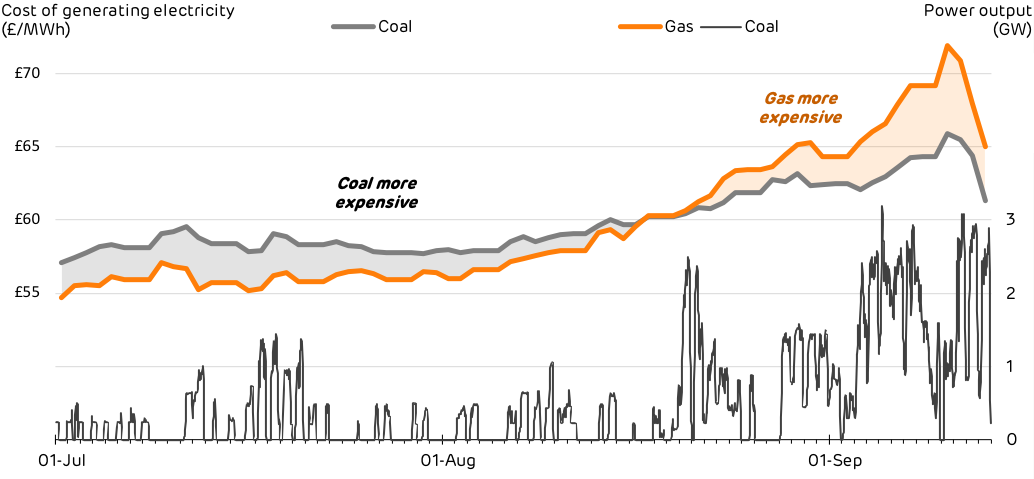
It became cheaper to generate power from coal than from gas (see thick lines, chart below) in late August.  Even though carbon prices now double the cost of generating electricity from coal,3 coal plants are consistently “in the money” at the moment, meaning they can generate power profitably all day and night.

Estimated cost of generating electricity from coal and gas in Quarter 3 (thick lines), and the output from coal power stations in Britain (thin line)

Estimated cost of generating electricity from coal and gas in Quarter 3 (thick lines), and the output from coal power stations in Britain (thin line)

The cost of emitting CO2 has increased sharply, up 45% so far this year due to the ongoing rally in European Emissions Trading Scheme (EU ETS) prices.  Rising carbon prices should make gas more economical to burn as it emits less than half the CO2 of coal.

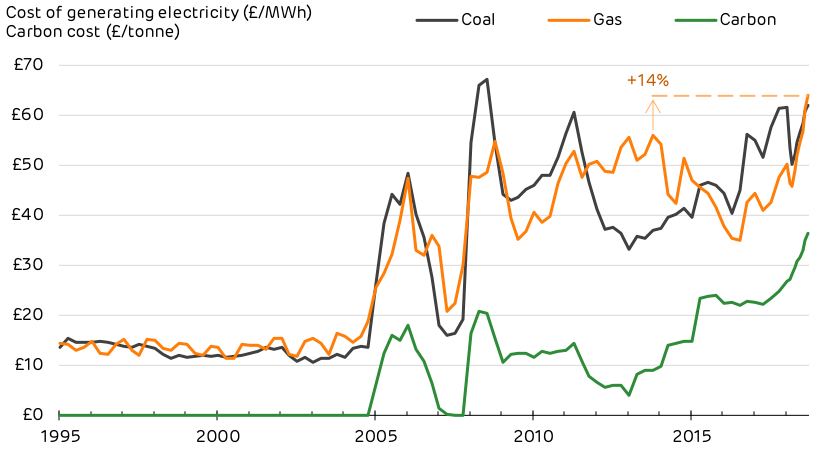
However, wholesale gas prices have also risen 40% since the start of the year, as supplies and storage are squeezed in the run up to winter.  Gas prices are at a ten-year high, currently 14% above their previous quarterly-average peak back in 2013 (see chart below).  These rising costs are feeding through into wholesale power prices, which have risen by a third over the past year to hit £60/MWh.

The cost of generating electricity and carbon cost

The estimated cost of generating electricity from fossil fuels over the last 20 years, along with the cost of emitting CO2.

Britain’s carbon price strengthened dramatically through 2014–15 due to the government implementing a Carbon Price Support scheme.  This caused gas to become competitive against coal for power generation, leading to carbon emissions from the power sector halving.  Unless Britain’s carbon price can once again make up the gap between coal and gas prices, we risk rolling back some of the world-leading gains made on cleaning up our electricity system.

The Committee on Climate Change has made it clear that power is the only sector that is pulling its weight when it comes to decarbonising the UK.  Clean electricity could power low-carbon vehicles and heating, but this opportunity will be wasted if the electricity comes from high-carbon coal.

UK electricity system

So what can be done?  The sharp rise in gas prices hints at a lack of flexibility in the energy system.  Britain came uncomfortably close to gas shortages in March, in part due to the closure of the country’s largest gas storage site.  With nearly half of the electricity generated in Britain coming from gas, plus five-sixths of household heat, diversifying into other – cleaner – energy sources would help insulate consumers and businesses from price spikes.

No one country has the power to determine international fuel prices.  Several factors have come together to push up gas prices, including a lack of transmission capacity, depleted stores of gas after the long hot summer and a lack of wind power increased output from gas-fired stations. Suppliers which don’t wish to be caught short after the Beast from the East, are also stocking up on gas.

Any knee-jerk reaction to try and lower the cost of electricity (for example, slashing the cost of carbon emissions) may only have a short-term impact, and could easily lead to longer-term damage (such as the resurgence of coal) which would require further interventions in the future.

Britain does have control over its carbon price. Its power stations and industry currently pay the Emissions Trading System price (determined on the Europe-wide market) which has fluctuated wildly over the past week between €25 (£22) and €19 (£17) per tonne, plus £18 per tonne in Carbon Price Support which goes to the Treasury.  This needs to be maintained or strengthened further to save the power system from backsliding, and to show strong climate leadership on the international stage.

Explore this data live on the Electric Insights website

View Drax Power CEO Andy Koss’ comment

Commissioned by Drax, Electric Insights is produced independently by a team of academics from Imperial College London, led by Dr Iain Staffell and facilitated by the College’s consultancy company – Imperial Consultants.


[1] The three-month average cost of generating electricity from gas exceeded £60/MWh for the first time since 2009.  Short-term price spikes have been higher than this, such as the first week of March during the Beast from the East.

[2] Extra generation from coal reduces the output from gas plants, which are their main competitors, as nuclear, wind and solar already run as much as possible.  Calculation based on 1934 MW of coal generation (the average during the first week of September) emitting 937 gCO2 per kWh (1812 tonnes per hour) instead of gas generation which would have emitted 394 gCO2 per kWh (762 tonnes per hour).

[3] The coal that must be burnt to produce 1 MWh of electricity now costs around £31, and the CO2 pollution costs an extra £31 on top.  For comparison, producing 1 MWh of electricity from gas costs £50 for the fuel and £15 for the CO2.

How to switch a power station off coal

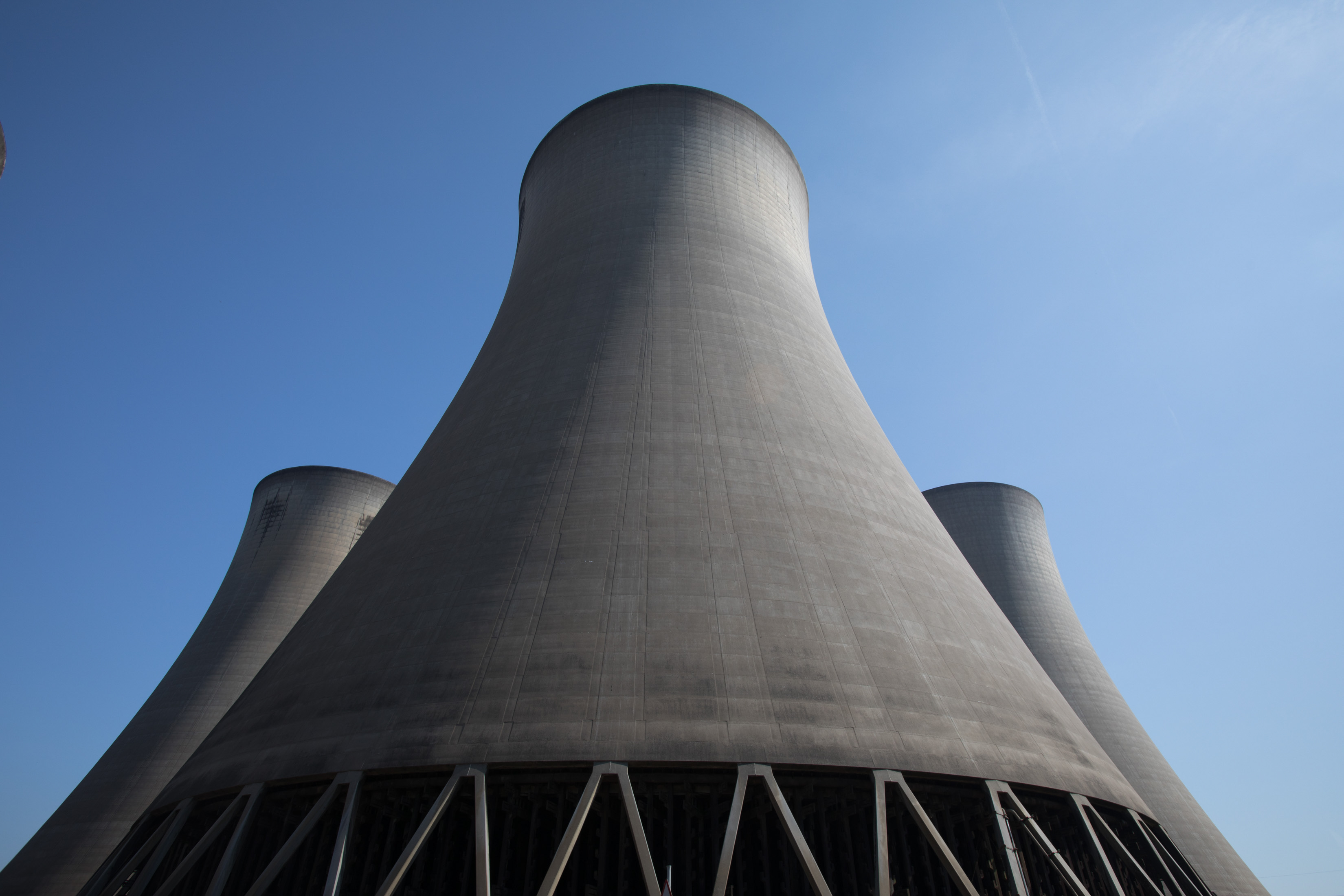
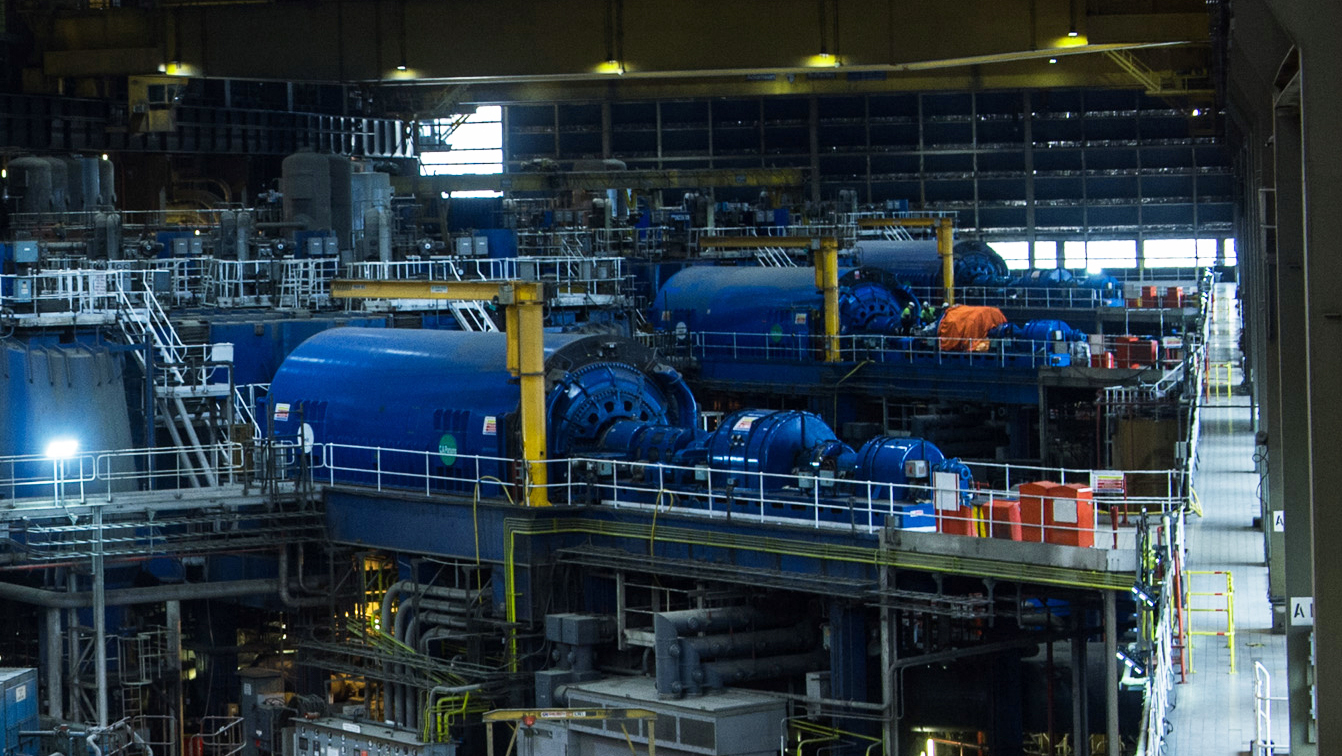
Turbine hall at Drax Power Station

In 2003, the UK’s biggest coal power station took its first steps away from the fossil fuel which defined electricity generation for more than a century. It was in that year that Drax Power Station began co-firing biomass as a renewable alternative to coal.

It symbolised the beginnings of the power station’s ambitious transformation from fossil-fuel stalwart to the country’s largest single-site renewable electricity generator. This plan presented a massive engineering challenge for Drax, with significant amounts of new knowledge quickly needed.

Fifteen years later, three of its generating units now run entirely on compressed wood pellets, a form of biomass, while coal has been relegated to stepping in only to cover spikes in demand and improve system stability.

Now Drax has converted a fourth unit from coal to biomass. This development represents the passing of a two thirds marker for the power station’s coal-free ambitions and adds 600-plus megawatts (MW) of renewable electricity to Great Britain’s national transmission system.

Building on the past

Drax first converted a coal unit to biomass in 2013, with two more following in 2014 and 2016. This put Drax in an interesting position going into a new conversion: on one hand, it is one of the most experienced generators in the world when it comes to dealing with and upgrading to biomass. On the other, it’s still relatively new to the low carbon fuel compared with its dealings with coal.

Adam Nicholson

“We’ve decades of understanding of how to use coal, but we’ve only been operating with biomass since we started the full conversion trials in 2011,” says Adam Nicholson, Section Head for Process Performance at Drax Power. “We’ve got few running hours under our belts with the new fuel versus the hundreds of man years of coal knowledge and operation all around the country.”

When converting a generating unit, the steam turbine and generator itself remain the same. The difference is all in the material being delivered, stored, crushed and blown into the boiler and burned to heat up water and create steam. And because biomass can be a volatile substance – much more so than coal – this process must be a careful one.

Drax could build on the learnings and equipment it had already developed for biomass such as specially built trains and pulverising mills, but storage proved a bigger issue. The giant biomass domes at Drax that make up the EcoStore are advanced technological structures carefully attuned to storing biomass, but for Unit 4, they were off limits.

Instead Drax engineers had to come up with another solution.

The journey of a pellet through the power station

Normally wood pellets are brought into Drax by train, unloaded and stored in the biomass domes before travelling through the power station to the mills and then boilers. Unit 4, however, sits in the second half of the station – built 12 years after the first. This slight change in location presented a problem.

“There’s no link from the eco store to Unit 4 at all,” explains Nicholson. “You can’t use the storage domes and that whole infrastructure to get anything to Unit 4.”

Drax engineers set about designing a new conveyor system that could connect the domes to the mills and boiler that powers Unit 4. After weeks of design, the team had a theoretical plan to connect the two locations with one problem: it was entirely uneconomical.

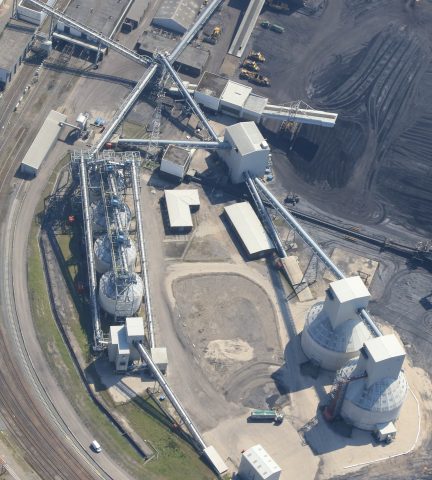
Rail unloading building 1 and storage silos

“If we were building a new plant it would be relatively easy, because you could plan properly and wouldn’t have existing equipment in the way,” says Nicholson.

“We had to plan around it and make use of the pre-existing plant.”

Within that pre-existing plant though were vital pieces of equipment, some of which had laid dormant since Drax stopped fuelling its boilers with a mixture of coal and biomass and opted instead for full unit conversions.

Drax began cofiring across all six units in 2003, using two different materials – a mix of around 5% biomass and 95% coal. A direct injection facility was added in 2005. It involved blowing crushed wood pellets into coal fuel lines from two of the power station’s 60 mills.

Then, the amount of renewable power Drax was able to generate roughly doubled in the summer of 2010 when a 400 MW co-firing facility became operational.

Back to the present day, it’s fortunate for the Unit 4 conversion that the co-firing facility includes its own rail unloading building (RUB 1) and storage silos. They are located much closer to the unit than the bigger RUB 2 and the massive biomass domes.

This solved the problem of storage but moving the required volumes of biomass through the plant without significant transport construction still posed a challenge.

Rail unloading building 1 and storage silos for Unit 4 [left], EcoStore biomass domes for units 1-3 [right]

To tackle this the team modified a pneumatic transport system, previously tested during co-firing, to have the capability to blow entire pellets from the storage facilities around the power station at speeds of more than 20 metres per second. The success of this system proved key – it was the final piece necessary to make the conversion of Unit 4 economical.

The post-coal future

Andy Koss

For now, Drax’s fifth and sixth generating unit remain coal-powered, but are called upon less frequently. With Great Britain set to go completely coal-free by 2025, there are plans to convert these too, but as part of a system of combined cycle gas turbines and giant batteries rather than biomass powered units.

It’s an opportunity for Drax to again leverage its pre-existing plant and provide the grid with a fast acting-source of lower-carbon electricity. As with converting to biomass, it will pose a complex new engineering challenge – one that will prepare Drax to meet the future needs of grid as it continues to change and demand greater flexibility from generators.

“The speed at which the Unit 4 project has been delivered is testament to the engineering expertise, skill and ingenuity we continue to see at Drax. We’re nimble and innovative enough to meet future challenges,” says Andy Koss, Chief Executive, Drax Power.

“We may look very different in 10 or 20 years’ time, but the ethos of that innovation and agility is something that will persist.”

Repowering the remaining coal plant with gas and up to 200 MW of batteries will sit alongside research into areas such as carbon capture, use and storage (CCuS) that is all geared towards expanding Drax Power beyond a single site generator into a portfolio of flexible power production facilities.

Unit 4’s conversion is more than just a step beyond halfway for the power station’s decarbonisation, but a significant step towards becoming entirely coal-free.

Find out more about Unit 4.

Great Britain is almost ready for coal-free summers

Every summer Great Britain uses less and less coal. This June the fossil fuel’s share of the electricity mix dipped below 1% for the first time ever – for 12 days it dropped all the way to zero.

Spurred on by the beginnings of an uncharacteristically dry, hot summer and a jump in solar generation, the possibility of the country going entirely coal-free for a full summer now looks more achievable than ever in modern times.

This is one of the key findings from Electric Insights, a quarterly report commissioned by Drax and written, independently, by researchers from Imperial College London. It found that across Q2 2018, there were as many coal-free hours as in the whole of 2016 and 2017 combined.

And while the report’s findings are hugely positive, they also hint at where development is still needed. What else does the performance of this quarter tell us about what we can expect in the power sector – in Great Britain and around the world?

Great Britain is slashing coal generation, the rest of the world needs to catch up

Great Britain has reduced its coal-fired power generation by four-fifths over the last five years. Last quarter the country’s coal fleet ran at just 3% of its 12.9 gigawatt (GW) capacity. Coal capacity is now lower than the capacity of solar PV panels (13.1 GW) installed nationwide, with the most recent decline resulting from Drax’s conversion of a fourth unit from coal to biomass.

When coal generation was running, it primarily provided system balancing services overnight in May and June rather than baseload electricity. However, this positive trend is not seen around the world.

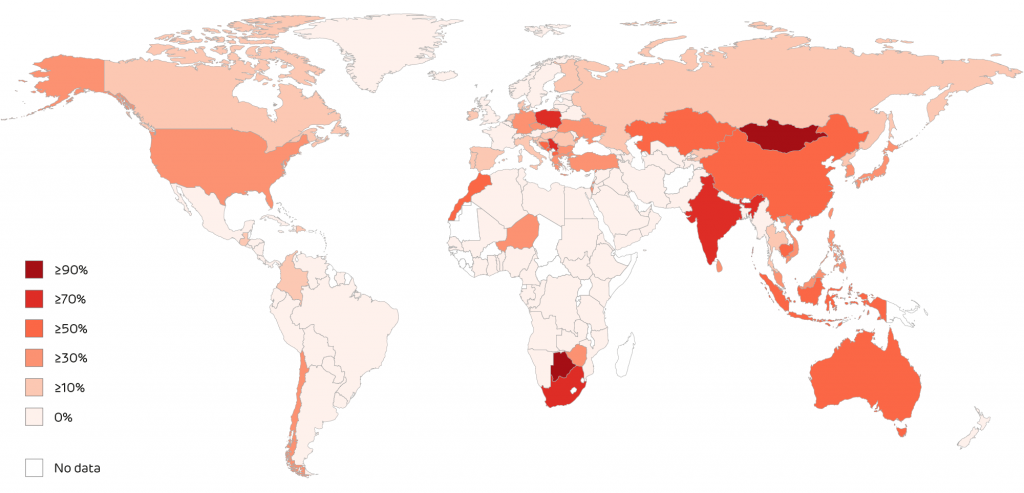
The share of coal in national power systems during 2017

Globally, coal still provides 38% of the world’s electricity – the same amount it did 30 years ago. This comes despite efforts in Europe and North America to move away from coal, and growing investment into renewable generation and technologies.

Overall, Europe’s coal generation dropped from 39% to 22% over the last 30 years, despite some countries – such as Poland and Serbia – still drawing significant generation from the fossil fuel. The US has also reduced its coal generation from 57% to 31% over the past 30 years, as natural gas proves more economical, even in an era of pro-coal policies.

However, in the Middle East and Africa (which draw significant generation from their oil and gas reserves) and South America (where coal accounts for less than 3% of generation), total coal generation is growing. In fact, globally, only seven countries use less coal today than 30 years ago: Germany, Poland, Spain, Ukraine, the US, Great Britain and Canada.

Electric Insights attributes part of this global growth to the continued increase in demand for electricity, particularly in Asia. China, South Korea and Indonesia collectively burn 10 times more coal than they did 30 years ago. India’s coal habit has also increased over the past decade to account for 76% of its electricity generation, while Japan’s usage has grown from 15% to 34% in the same period.

As well as the stresses created by growing demand, this highlights a global disparity in the approach to decarbonising electricity systems, and a need for longer-term, environmentally and socially-conscious market-based initiatives that encourage meaningful movement to lower-carbon electricity sources, such as the UK and Canada’s Powering Past Coal Alliance.

Read the full articles here:

(Lack of) progress in global electricity generation

Britain edges closer to zero coal

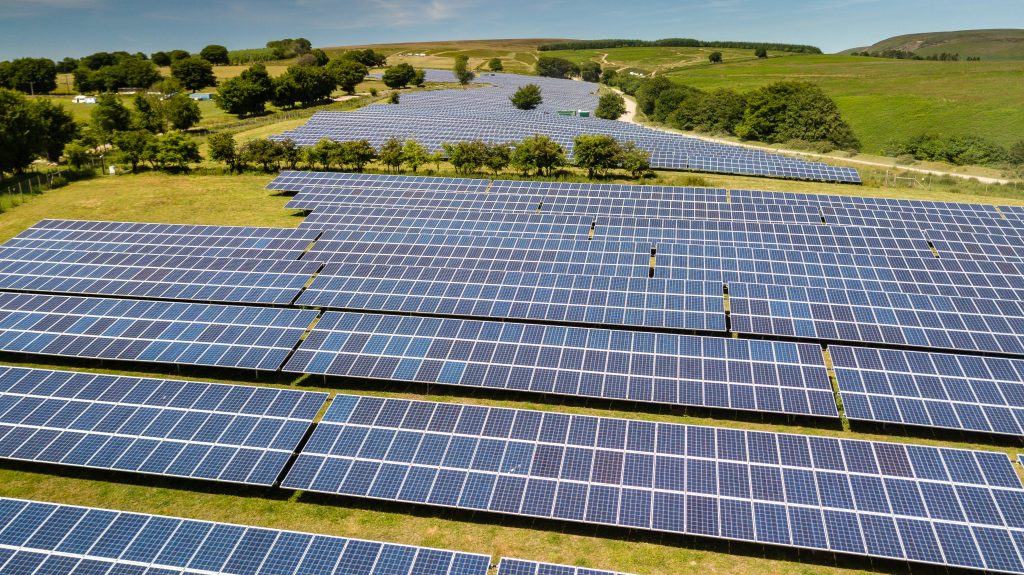
Solar farm in South Wales

Decarbonisation is growing, but it’s going to get harder

Great Britain’s decline in coal use has rapidly accelerated its decarbonisation efforts. Annual coal power station emissions have shrunk over the past five years from 129 to 19 million tonnes of CO2 and helped reduce the average carbon intensity of electricity generation to a record low of 195 g/kWh last quarter.

However, this rapid pace of decarbonisation is unlikely to be sustained as growth in renewables faces a plateau, the country’s current nuclear capacity reaches retirement and the target of moving beyond coal by 2025 is completed.

Renewable sources now account for a steady 25% of annual electricity generation. These sources largely came onto the system through policies such as the government’s Renewables Obligation, which is now closed to entrants; Contracts for Differences, the future of which is uncertain for mature technologies like onshore wind and solar; and Feed-in Tariffs for roof-top solar installations which will close in April 2019. The end of these initiative paints a hazy picture of how future renewable capacity will be brought into the system.

Nuclear capacity also looks unlikely to expand at the rate needed to plug gaps in demand, with half of the country’s fleet expected to close for safety reasons by 2025. The Hinkley Point C nuclear power station, meanwhile, is only expected to come online at the end of that year.

Read the full article here:

Has Britain’s power sector decarbonisation stalled?

Ramsgate, Kent during summer 2018 heatwave

Weather will continue to play a major part in renewable generation

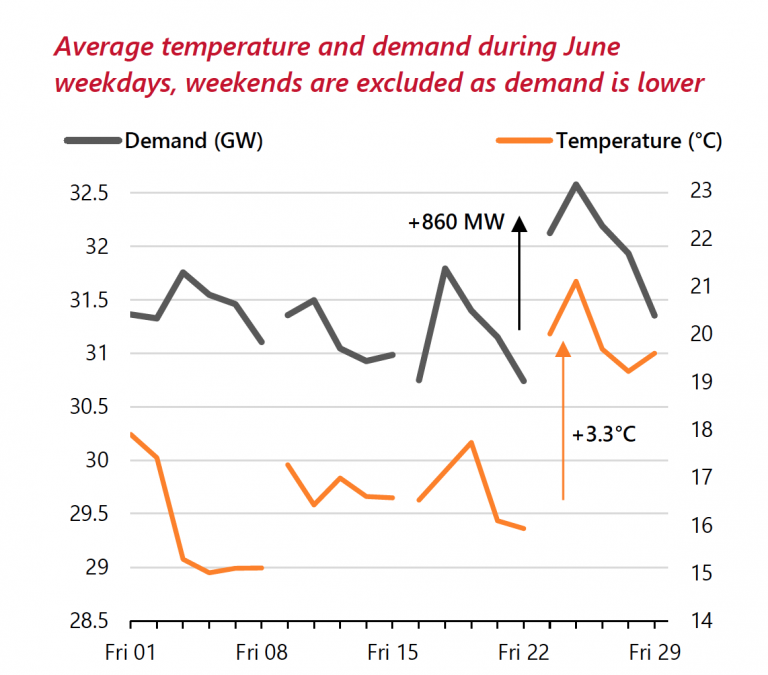
If the first quarter of 2018 was defined by low temperatures and heavy snowfall, the second quarter saw the impact of the opposite in weather conditions. From 23 June a heatwave set in around the country that saw temperatures increase by 3.3oC in a week, driving demand to jump 860 MW – the equivalent of an extra 2.5 million households, or an area the size of Scotland.

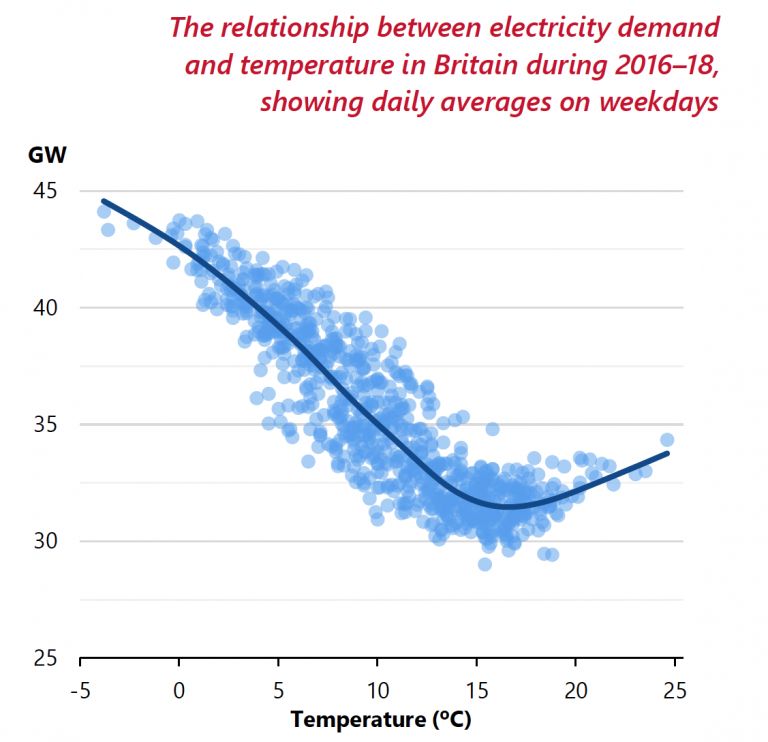
The increase in demand isn’t as drastic as when cold fronts hit, but if summers continue to get hotter this could change. Today, winter-time demand increases by 750 MW for every degree it drops below 14oC as electric heaters are plugged in to aid largely gas-based central-heating systems. When the mercury rises, however, demand increases by 350 MW for every degree rise over 20oC as businesses turn on air conditioning and the country’s refrigerators work harder.

These heatwave spikes are, at the moment, more easily dealt with than winter storms. While the Beast from the East saw demand reaching a peak of 53.3 GW, June’s topped out at 32.5 GW. The clear skies and long days of June also meant solar PV generation soared, making up for the ‘wind drought’ caused by the high-pressure weather. Wind output floated between 0.3 GW and 4.3 GW in June, far below its quarter peak to 13 GW. However, solar made up for this by peaking past 8 GW for 13 days in June and setting a new record of 9.39 GW at lunchtime on 27 June.

Read the full articles:

How the heat wave affects electricity demand

The summer wind drought and smashing solar

Explore the data in detail by visiting ElectricInsights.co.ukRead the full report.

Commissioned by Drax, Electric Insights is produced, independently, by a team of academics from Imperial College London, led by Dr Iain Staffell and facilitated by the College’s consultancy company – Imperial Consultants.

How the heatwave affects electricity demand

16.5 degrees is the Goldilocks temperature for the Brits – not hot enough for air-con, not too cold to put the heating on. In March we saw how the Beast from the East caused a surge in demand, now the long summer heatwave is doing the same.

June 23rd marked the start of the heatwave, with daytime temperatures surpassing 30°C in Scotland and Wales. The last week of June was 3.3°C warmer than the previous week, and demand was 860 MW higher (see chart below). This rise is equivalent to power demand from an extra 2.5 million households.

This reflects the growing role of air conditioning and refrigeration in shops, and cooling for data centres. Global electricity demand from cooling is rising dramatically, and is seen as a ‘blind spot’ in the global energy system.  This will become more important as global temperatures, and more importantly, global incomes rise. However, it is easier to deal with than cold spells during winter because demand is low and solar PV output is high.

Below 14°C, demand increases by 750 MW for every degree it gets colder as buildings need more heating. Around a tenth of British homes have electric heating, as do half of commercial and public buildings. And while the UK is not synonymous with air conditioners, demand rises by 350 MW for each degree that temperature rises above 20°C.

This effect may well grow stronger in the coming years. National Grid expect that the peak load from air conditioners will triple in the coming decade. Perhaps events such as the current prolonged heatwave may spur more households to invest in air conditioning.

Read the press release

Explore power grid data during the heatwave beginning 23rd June

Commissioned by Drax, Electric Insights is produced independently by a team of academics from Imperial College London, led by Dr Iain Staffell and facilitated by the College’s consultancy company – Imperial Consultants.

Half year results for the six months ended 30 June 2018

RNS Number :  5142V
Drax Group PLC
Six months ended 30 JuneH1 2018H1 2017
Key financial performance measures
EBITDA (£ million)(1)102121
Underlying earnings (£ million)(2)79
Underlying earnings per share (pence)(2)1.62.2
Interim dividends (pence per share)5.64.9
Net cash from operating activities (£ million)112197
Net debt (£ million)(3)366372
Statutory accounting measures
Operating profit/(loss) (£ million)12(61)
Loss before tax (£ million)(11)(104)
Reported basic loss per share (pence)(1)(21)

Financial and Operational Highlights

  • H1 EBITDA lower year on year due to two unplanned outages, other areas performing well
  • Statutory loss before tax includes lower level of H1 EBITDA and asset write off
  • Refinancing complete – swapped floating for fixed rate debt with 7.5-year maturity
  • Sustainable and growing dividend
    • Increase in 2018 interim dividend to £22.4 million (5.6 pence per share) (H1 2017: £20 million)
    • Expected 2018 full year dividend of £56 million
    • Ongoing £50 million share buy-back programme – £13 million at 30 June 2018

Good progress with strategic initiatives, on track to deliver long-term objectives

  • Third biomass pellet plant, LaSalle Bioenergy, commissioning ahead of plan – full capacity Q1 2019
  • Conversion of fourth biomass generating unit on schedule and budget, commissioning late summer
  • Programme for long-term reduction in biomass cost including sawmill co-location and rail spur investment
  • Confident in growing requirement for system support services over coming years
  • Development of options for future generation:
    • Coal-to-gas repowering – detailed planning application accepted for review June 2018
    • Four OCGTs(4) – two projects in next capacity market auction, planning applications accepted for review for remaining two projects
  • B2B Energy Supply delivering solid progress to grow number of customer meters

2018 outlook

  • Full year financial expectations unchanged
    • Generation – fourth biomass unit conversion, improved margins, on target availability and capacity payments
    • Continued growth in Pellet Production and B2B Energy Supply
  • Capital Markets Day, 13 November

Will Gardiner, Chief Executive of Drax Group plc, said:

“Drax continues to be at the heart of decarbonising UK energy, securing government support to convert a fourth unit to biomass and piloting a Bioenergy Carbon Capture and Storage project, supporting the UK Government’s carbon capture and storage ambitions.

“Full year EBITDA expectations remain unchanged. However, first half EBITDA was lower, principally due to two specific generation outages. We made excellent progress with our Pellet Production business, driving down costs while producing at record levels and our B2B Energy Supply business continues to increase customer numbers. We also remain on track with our investment projects: the conversion of a fourth unit to biomass, and the development of our OCGT and coal-to-gas repowering options.

“We remain focused on safe and efficient operations and returns to shareholders and expect to declare a full year dividend of £56 million for 2018.”

Group Financial Review

  • Increase to operating profit includes unrealised gains on derivative contracts of £24 million (2017: loss £86 million)
  • Decrease in underlying earnings per share – principally reflects lower EBITDA from biomass generation in H1 2018 vs H1 2017
  • Reported basic earnings per share – a loss of 1.0 pence, which includes write off of coal-specific assets (£27 million) following commencement of fourth biomass unit conversion, largely offset by unrealised gains on derivative contracts (£24 million)
  • Tax – tax credit reflecting benefit of Patent Box claims
  • Capital investment of £46 million, full year investment expectation unchanged at £100–£110 million
    • Core maintenance (£50 million), improvement and optimisation projects (£20-£30 million) and conversion of a fourth biomass unit (£30 million)
  • Net debt of £366 million (31 Dec 2017: £367 million), including cash on hand of £245 million

Operational Review

Pellet Production – Good quality pellets at lowest cost

  • EBITDA up £14 million to £10 million
    • 80% increase in pellet production to 0.7 million tonnes (H1 2017: 0.4 million tonnes)
    • 12% reduction in cost per tonne
  • LaSalle Bioenergy (LaSalle) commissioning complete, full capacity Q1 2019
  • Biomass cost reduction initiatives
    • Co-location and offtake agreement with Hunt Forest Products for low-cost sawmill residues at LaSalle
    • Investment in LaSalle rail spur (£11 million) – reduced transport cost to Baton Rouge port facility

Power Generation – Optimisation of existing assets and decarbonisation projects

  • EBITDA down £49 million to £88 million
    • Rail unloading building outage restricted operation of two ROC(5) units (January 2018)
    • Generator outage on one ROC(5) unit (February 2018)
    • System support and flexibility £36 million (H1 2017: £48 million) – lower due to specific Black Start contract (Q1 2017)
    • Offset by 2016 insurance proceeds and lower carbon cost following decision to convert a fourth unit to biomass
  • Electricity output (net sales) down 17% to 8.9TWh (H1 2017: 10.7TWh)
    • Two unplanned outages on ROC(5) units in Q1 and reduced coal generation
    • High biomass availability in Q2
  • 71% of generation from biomass (H1 2017: 68%)
  • Commenced Bioenergy Carbon Capture and Storage (BECCS) pilot project, £0.4 million cost

B2B Energy Supply – Profitable business with growth in customer meters

  • EBITDA up £4 million to £16 million
    • 9% increase in customer meter points to 387,000 (H1 2017: 356,000)
    • Increase in bad debt reflecting challenging business environment for some customers
  • Strong renewable proposition – 59% of sales renewable
  • Continued investment in next generation IT systems
  • Development of flexibility and system support market

Notes:

  1. EBITDA is defined as earnings before interest, tax, depreciation, amortisation and material one-off items that do not reflect the underlying trading performance of the business.
  2. Underlying earnings exclude unrealised gains on derivative contracts of £24m (H1 2017: unrealised losses of £86m) and material one-off items that do not reflect the underlying performance of the business (finance costs of £7m (2017: £24m), acquisition and restructuring costs of £3m (2017: £6m), write off of coal-specific assets of £27m (H1 2017: £Nil), and the associated tax effect.
  3. Borrowings less cash and cash equivalents.
  4. Open Cycle Gas Turbine.
  5. Renewable Obligation Certificate.

View complete half year report

View analyst presentation

Notice of half year results announcement

RNS Number : 9363U
Drax Group PLC

Drax Group plc (“Drax”) confirms that it will be announcing its Half Year Results for the six months ended 30 June 2018 on Tuesday 24 July 2018.

Information regarding the results presentation meeting and webcast is detailed below.

Results presentation meeting and webcast arrangements

Management will host a presentation for analysts and investors at 9:00am (UK Time), Tuesday 24 July 2018, at JP Morgan, 60 Victoria Embankment, London, EC4Y 0JP. 

Would anyone wishing to attend please confirm by e-mailing [email protected] or calling Christopher Laing at FTI Consulting on +44 (0)20 3319 5650. 

The meeting can also be accessed remotely via a live webcast, as detailed below. After the meeting, the webcast will be made available and access details of this recording are also set out below.

A copy of the presentation will be made available from 7:00am (UK time) on Tuesday 24 July 2018 for download at: www.drax.com>>investors>>results-reports-agm>> #investor-relations-presentations or use the link https://www.drax.com/investors/results-reports-agm/#investor-relations-presentations

Event Title:

Drax Group plc: Half Year Results

Event Date:

Tuesday 24 July 2018

Event Time:

9:00am (UK time)

Webcast Live Event Link:

https://cache.merchantcantos.com/webcast/webcaster/4000/7464/16531/105055/Lobby/default.htm

Start Date:

Tuesday 24 July 2018

Delete Date:

Monday 15 July 2019

Archive Link:

https://cache.merchantcantos.com/webcast/webcaster/4000/7464/16531/105055/Lobby/default.htm

For further information please contact Christopher Laing on +44 (0)20 3319 5650.

Website:

www.drax.com


Balancing for the renewable future

It’s not news to say Great Britain’s electricity system is changing. Low carbon electricity sources are on course to go from 22% of national generation in 2010 to 58% by 2020 as installation of wind and solar systems continue to grow.

But while there has been much change in the sources fuelling electricity generation, the system itself is still adapting to this transformation.

When the national grid was first established in the 1920s, it was designed with coal and big spinning turbines in mind. It meant that just about every megawatt coming onto the system was generated by thermal power plants. As a result, the mechanisms keeping the entire system stable – from the way frequency and voltage is managed to how to start up the country after a mass black out – relied on the same technology. These ‘ancillary services’ – those that stabilise the system – are crucial to maintaining a balanced electricity system.

“Ancillary services are needed to make sure demand is met by generation, and that generation gets from one place to the next with no interruptions,” explains Ian Foy, Head of Ancillary Services at Drax. “Because what’s important is that all demand must be met instantaneously.”

In today’s power system, however, weather dependent technology like offshore wind and home solar panels are increasingly making up the country’s electricity generation. Their intermittency or variability is, in turn, impacting both the stability of the grid and how ancillary services are provided.

Running a large power system with as much as 85% intermittent generation – for example on a very windy, clear, sunny day – is thought to be achievable. It isn’t a scenario anticipated for the large island of Great Britain. But to deal with the fast-pace of change on its power system which recently managed to briefly achieve  47% wind in its fuel mix, there is a need to develop new techniques, technologies and ways of working to change how the country’s grid is balanced.

New storage tech takes on balancing services

One of the technologies that’s expected to provide an increasing amount of balancing services is grid-scale batteries. One stabilisation function offered by batteries (and other electricity storage options) is to provide reserve  at times when demand peaks or troughs. This matches electricity demand and generation.

Combined with their ability to respond quickly to changes in frequency, batteries can be a significant source of frequency response.

Batteries can also absorb and generate reactive power, which can then be deployed to push voltage up or down when it starts to creep too far from the 400kV or 275kV target (depending on the powerlines the electricity is travelling along) needed to safely move electricity around the grid.

The challenge with batteries is that the quantity of megawatt hours (MWh) required to compensate for intermittency is very large. The difference between the peak and trough on any day may be more than 20 GW for several hours (see for yourself at Electric Insights).

The significant price reductions in battery storage apply to technologies with short duration (or low volume MWhs). These are the technologies which have been developed at scale recently but will probably struggle to make up in any large quantity any shortfalls in generation resulting from prolonged periods of low intermittent generation.

A challenge currently being addressed relates to maintenance of battery state of charge. This is a consequence of battery storage having a cycle efficiency of less than 100%. This means that losses from continuous charging and recharging will have to be replenished from the available generation to avoid batteries going empty and being unavailable for grid services.

Ultra-low carbon advances

Rather than relying on batteries to provide ancillary services to support intermittent generation, technical advancements are allowing the wind and solar facilities – which are generating more and more of the country’s electricity – to do so themselves.

The traditional photovoltaic (PV) inverters found on solar arrays were initially designed to push out as much active, or real, power as possible. However, new smart PV inverters are capable of providing or absorbing reactive power when it is needed to help control voltage, as well as continuing to provide active power.

The major advantage of smart inverters is the limited equipment update required to existing solar farms to allow them to offer reactive power control. The challenge here is that PV is embedded in distribution systems and therefore reactive services they provide may not cure all the problems on the transmission system.

Similarly, existing wind installations have traditionally focused on getting the greatest amount of megawatts from the available resources, but with fewer thermal power stations on the grid, ways of balancing the system with wind turbines are also being developed.

Inertia is the force that comes from heavy spinning generators and acts as a damper on the system to limit the rate of change of frequency fluctuations. While wind turbines have massive rotating equipment, they are not connected to the grid in a way that they automatically provide inertia, however, research is exploring what’s known as ‘inertial response emulation’ that may allow wind turbines to offer faster frequency response.

This works through an algorithm that measures grid frequency and controls the power output of a wind turbine or whole farm to compensate for frequency deviations or quickly provide increases or decreases in power on the system. Inertial response emulation cannot be a complete substitute for inertia but can reduce the minimum required inertia on the system.

Even in a future where the majority of the country’s electricity comes from renewable sources, thermal generators may still be able to provide benefits to the system by running in ‘synchronous compensation’ mode i.e. producing or consuming reactive power without real power.

However, what is vitally important for the future of balancing services in Great Britain is a healthy, transparent and investable market for generators, demand side response and storage, whether connected on the transmission or distribution networks.

A market for the future grid

One of the primary needs of balancing service providers is greater transparency into how National Grid procures and pays for services. Currently, National Grid does not pay for inertia. With it becoming more important to grid stability, incentive is needed to encourage generators with the capability to provide it. Those technologies that can’t provide inertia, could be encouraged to research and develop ways they could do so in the future.

Standardising the services needed will help ensure providers deliver balancing products to the same level needed to support the grid. It would also benefit from fixed requirements and timings for such services. Bundling related products, such as reserve and frequency control, and active power and voltage management, will also offer operational and cost efficiencies to the providers.

Driving investment in balancing services for the future, ultimately, requires the availability of longer-term contracts to offer financial certainty for the providers and their investors.


Bridge to the future

The energy mix -- table showing services which can be provided by different power technologies

Click to view larger graphic.

For the challenges of decarbonisation to be met in a socially responsible way, Great Britain’s power system must be operated at as low a cost as possible to consumers.

With new technologies, almost anything could be possible. But operating them has to be affordable. In many cases, it may take time for costs of long duration batteries to come down – as it has with the most recent offshore wind projects to take Contracts for Difference (CfDs) and Drax’s Unit 4 coal-to-biomass conversion under the Renewables Obligation (RO) scheme.

Thermal power technologies such as gas that has proven capabilities in ancillary services markets can at least be used in a transitional period over the coming decades until a low carbon solution is developed.

Biomass will continue to be an important source of flexible power. This summer, at Drax, biomass units are helping to balance the system. It is the only low carbon option which can displace the services provided by coal or gas entirely.


Drax Power Station’s control room. Viewing on a computer? Click above and drag. On a phone or tablet – just move your device.

In the past the race to decarbonisation was largely based around building as great a renewable capacity as possible. This approach has succeeded in significantly scaling up carbon-free electricity’s role on Great Britain’s electricity network. However, for the grid to remain stable in the wake of this influx, all parties must adapt to provide the balancing services needed.

This story is part of a series on the lesser-known electricity markets within the areas of balancing services, system support services and ancillary services. Read more about black startsystem inertiafrequency responsereactive power and reserve power. View a summary at The great balancing act: what it takes to keep the power grid stable and find out what lies ahead by reading Maintaining electricity grid stability during rapid decarbonisation.