




Tag: investors

Do electric vehicles actually reduce carbon emissions?

Redcar Sunset

Electric vehicles (EVs) are often seen as a key driver towards a greener future. Indeed, transport accounts for roughly a quarter of the UK’s greenhouse gas emissions and seriously affects air quality in major cities.

To tackle pollution problems, governments around the world are implementing ambitious policies to promote the electrification of transport and phase out ICE (internal combustion engine) vehicles. The UK and France both plan to ban the sale of petrol- and diesel-only cars by 2040 while India is setting an even more ambitious end date of 2030.

Added to this are EVs’ growing popularity with drivers. There are now almost 110,000 electric cars and vans on UK roads spurred on by lowering battery costs and a growing range of models. Including plug-in hybrid vehicles, EVs now account for 2% of new registrations.

Switching to EVs is an obvious way to massively cut pollution in areas of dense traffic. But the question remains – how clean are EVs on the broader scale, when you look at the electricity used to charge them? 

Electric vehicle

Electric vehicles are getting cleaner

EVs don’t give off the same exhaust emissions as engines, but the power in their batteries has to come from somewhere. Follow the flow back from the car, through the charging point, all the way back to the power station and it’s likely some of that electricity is coming from fossil fuels. And that means emissions.

“They weren’t as green as you might think up until quite recently,” says Dr Iain Staffell, a researcher at Imperial College London and author of Electric Insights – a study commissioned by Drax that analyses electricity generation data in Britain. “Now, thanks to the rapid decarbonisation of electricity generation in the UK, EVs are delivering much better results,” he continues.

In fact, year-round average emissions from EVs have fallen by half in the last four years thanks to greener electricity generation. Today, they are twice as efficient as conventional cars.

Take the Tesla Model S. In the winter of 2012, producing the electricity for a full charge created 124g of carbon emissions per km driven, roughly the same as a 2L Range Rover Evoque. Now the carbon intensity of charging a Tesla has nearly halved to 74g/km in winter and 41 g/km in summer, as the UK continues to break its own renewable energy records. For smaller EVs, the results are even better. The Nissan Leaf and BMW i3 can now be charged for less than half the CO2 of even the cleanest non-plug-in EV, the Toyota Prius Hybrid.
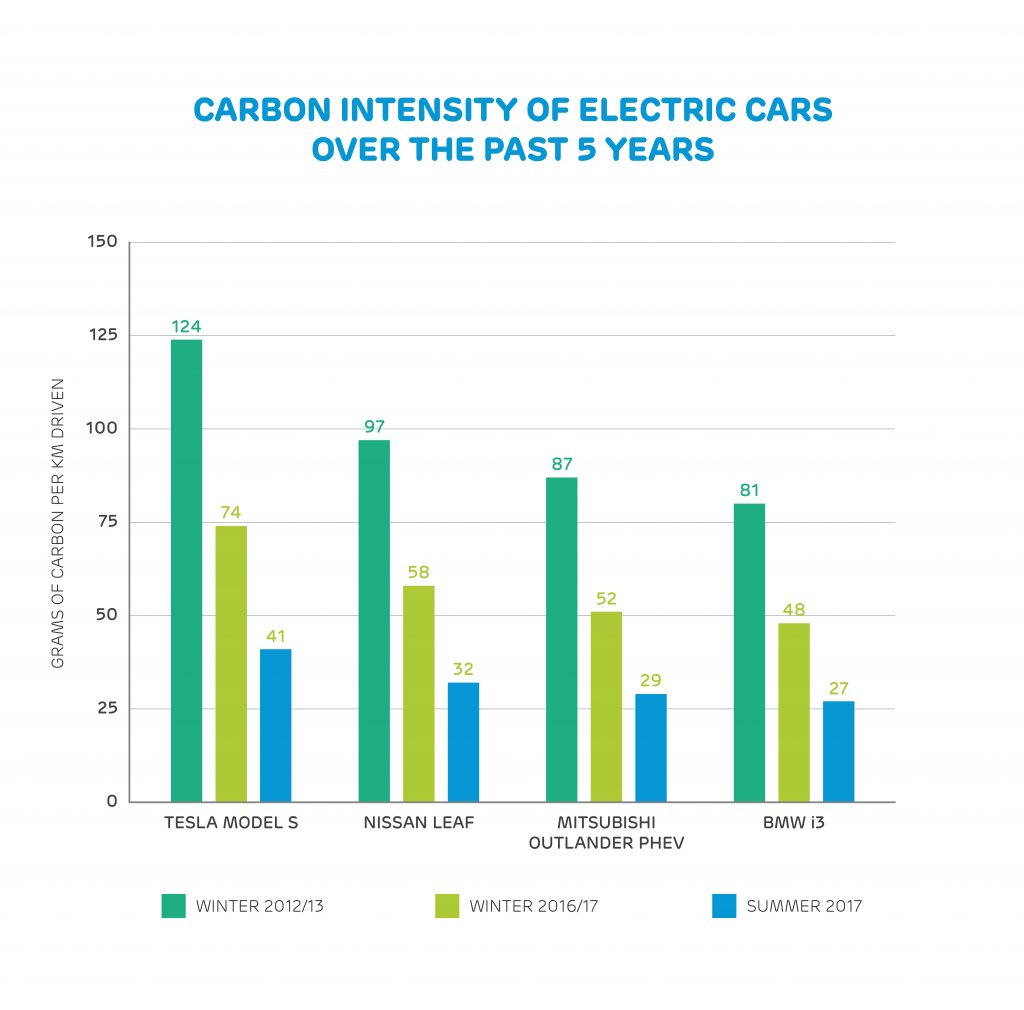
Carbon intensity of electric vehicles

So, the current outlook for EVs is hugely positive – but as their numbers continue to increase, will the demand they add to the grid put their clean credentials at risk?

Will EVs accelerate electricity demand?

The National Grid suggests there could be as many as nine million EVs on UK roads by 2030, which could lead to an additional 4-10 GW of demand on the system at peak times. This, in some cases, could lead to a rise in emissions.

Electricity demand in Britain typically peaks between 6pm and 10pm, when people arrive home and switch on lights and appliances. If you were to charge your EV between those evening hours, the emissions would be 8% higher than reported in the chart above. If you charged between midnight and 6am, they would be 10% lower.

Today, this demand is met by the existing mix of power stations (which last quarter included more than 50% renewable and low-carbon sources). But when there are sudden spikes in demand above this typical usage, the National Grid must call in the help of carbon-intensive reserve generators, such as coal-powered stations. Polluting diesel generators are also on standby around the UK, ready to turn on and feed into regional distribution grids at a moment’s notice.

To meet the challenge of peak-time EV charging, less carbon intensive power generation, storage and smart power management systems are needed. These include rapid response gas power stations such as the four Drax OCGTs planned to come online in the early 2020s, as well as grid-scale batteries, home-based batteries and demand-side response schemes. As the share of intermittent renewable capacity on the grid increases, more back-up power needs to be available for when the wind doesn’t blow and the sun doesn’t shine.

Keeping our future fuels clean

A future increasingly relying on back-up generators is far from inevitable, especially if the use of smart technology and smart meters increases. By analysing electricity costs and country-wide demand, smart meters have the potential to ensure EVs only charge outside peak times (unless absolutely necessary), when electricity is more likely to come from renewable or low-carbon and cheaper sources.

If the grid continues to decarbonise through advances in renewable technologies and lower-cost coal-to-biomass conversions, the potential of EVs’ electricity coming with associated emissions is diminished even further.

There is no doubt that EVs will make up a significant part in the future of our mobility. That they will also play a part in the future of cleaning up that mobility is as good as assured, but on this journey, it’s imperative we keep our eyes on the road.

Commissioned by Drax, Electric Insights is produced independently by a team of academics from Imperial College London, led by Dr Iain Staffell and facilitated by the College’s consultancy company – Imperial Consultants.

What you need to know about Britain’s electricity last quarter

Drax EI header

For an hour over lunch on Wednesday, 7th June, more than 50% of Britain’s electricity came from renewables. It was only the second time this had ever happened – the first had come just two months earlier, in April.

The second quarter (Q2) of 2017 was a period largely made up of firsts for Britain’s electricity system. While there were only two instances of renewable power tipping the 50% mark between April and June, overall, wind, solar, biomass and hydro energy made up more than a quarter of all Britain’s electricity for the first time ever.

These findings come from Electric Insights, research on Britain’s power system, commissioned by Drax and written by top university academics. Over the past year, the quarterly report has shown breaking renewable records is becoming the new normal for Britain’s electricity. Last quarter was no different.

Here, we look at the key findings from Q2 2017 and what they mean for the changing nature of the energy sector.

Daily electricity generation graph

More than half Great Britain’s electricity came from renewables. Twice

Wind, solar, biomass and hydro accounted for 51.5% of the UK’s electricity for an hour on 7th June, generating 19.1 gigawatts (GW). Combined with nuclear power and imports from France, low-carbon output was a record 28.6 GW – a massive 89% of total demand. This followed 30th April, when Britain’s electricity edged over the 50% renewable mark for a shorter, but no less significant, period.

The percentage of renewables making up our power supply is set to grow as additional renewable capacity comes onto the grid. There is currently 6 GW of additional wind capacity being constructed in Britain. Solar capacity has already hit 12.4 GW – more solar panels than analysts thought would be installed by 2050. Plans to convert more of Britain’s coal units to biomass will increase the availability of renewable power further, still.

25% electricity infographic

Electricity was cleaner than ever

There was a key date in the history of coal during Q2. On 21st April, Britain recorded the first full day it had gone without burning any coal since 1882 – the year Holborn Viaduct power station became the world’s first coal-fired public electricity station.

While that date is symbolic of the UK’s shift away from coal, in practice, it means carbon emissions are also dropping to historically low levels. Carbon intensity reached a new low in Q2, averaging 199 g/kWh over the quarter – 10% lower than the previous minimum set last year. For context, carbon intensity averaged 740 g/kWh in the 1980s and 500 g/kWh in the 2000s.

An important indicator of this falling carbon intensity is that Britain’s electricity now regularly drops below 100 g/kWh, and reached an all-time low of 71 g/kWh on the sunny and windy Sunday of 11th June.

100,000 electric vehicles infographic

Electric cars are cleaner than before

One of the greatest decarbonisation challenges moving forward is how we transform transport. Electrification is the primary driver of change in this sector, and Q2 saw Britain hit a significant milestone as the total number of electric vehicles (EVs) in the country surpassed 100,000.

The potential of EVs in cleaning up transport is significant, but there are also concerns they could, in some cases, increase CO2 levels due to pollution from power stations. However, as the last quarter’s data shows, EVs are in fact twice as carbon efficient as conventional cars thanks to the amount of renewable and low carbon electricity on the system.

“According to our analysis, looking at a few of the most popular models, EVs weren’t as green as you might think up until quite recently,” says Dr Iain Staffell From Imperial College London. “But now, thanks to the rapid decarbonisation of electricity generation in the UK they are delivering much better results.”

25% solar infographic

The most solar power a quarter has ever seen

The longer days in Q2 enabled solar power to become a key source of electricity, and for eight hours over the quarter it generated more than all fossil fuels combined. It also set output records by supplying 25% of total demand on 8th April, and producing 8.91 GW on 26th May.

While wind remains the largest source of renewable energy generation in the UK, solar’s influence is growing – especially as decentralisation of the power system continues to proliferate.

Of Britain’s 12.4 GW solar capacity, 57% is concentrated in 1,400 solar farms of around 5 MW each, while the rest is distributed across almost one million rooftop arrays in homes, businesses and other institutions. In fact, during June, 10% of all Britain’s electricity came from these sorts of decentralised sources – sources of power not on the national grid.

This is unlikely to spell a fundamental shift to an entirely decentralised power grid in the short term, but it does hint at the changes the sector is seeing. From its carbon profile, to its variety, to its flexibility, Britain’s power system is changing – and that’s a good thing.

10% decentralised energy infographic

Explore the data in detail by visiting ElectricInsights.co.uk

Commissioned by Drax, Electric Insights is produced independently by a team of academics from Imperial College London, led by Dr Iain Staffell and facilitated by the College’s consultancy company – Imperial Consultants.

A flexible energy future

Renewable technologies now account for a larger proportion of Great Britain’s electricity sources than ever before. And they’re growing.

The first quarter of 2017 was another record-breaking one for renewables. Biomass, wind and hydro all registered their highest energy production ever, while solar recorded its highest ever peak output. Drax’s own generation is now 68% renewable and accounted for 17% of the country’s overall renewable generation in the first half of 2017 – enough to power over four million homes.

We’ve made great progress over a relatively short period. However, with every step forward we need to ensure our approach is helping enhance stability. In a power system increasingly made up of intermittent renewables, what will become more and more important for security of electricity supply will be technologies that respond quickly to spikes in demand and drops in supply – for example, when the sun isn’t shining and the wind isn’t blowing.

In short, what the power system of today needs is flexibility.

 The flexibility factor

A recent report by Imperial College London for the Committee on Climate Change (CCC) highlights the significance of increasing system-wide flexibility in achieving decarbonisation. Imperial’s analysis emphasises the cost savings this can have, projecting that flexibility in a 50 g/kWh system – the lower-end of the CCC’s 2030 target for a decarbonised system – could save between £7.1 billion and £8.1 billion a year in system integration costs.

Without flexibility, the costs of balancing the system will rise significantly. This, in turn, could lead to the current fast-pace of grid decarbonisation stalling.

The need for flexibility in our energy system is too financially and environmentally significant to ignore. But what sources and technologies will we need to create it?

The next big thing in system flexibility

There are a number of technologies that are often touted as key to a flexible system, including storage (principally batteries), interconnectors, rapid response gas plants, renewable technologies such as biomass, and demand side response. All are indeed crucial to a flexible future, but alone each one still has its challenges.

Millions of pounds are being invested in battery and storage research – both in the ambition of driving down costs and in increasing capacity. However, there is a way to go on both fronts. For example, consider the scale at which batteries must operate.

The storage domes at Drax Power Station hold up to 300 kt of wood pellets – enough to generate roughly 600 GWh of electricity. At the current battery prices of around £350 per kWh it would cost £210 billion to replace their capacity with batteries. Even if prices fell dramatically we are still talking about a £60 billion price tag.

Greater interconnection is something energy industry regulator Ofgem and the National Infrastructure Commission (NIC) are calling for, but National Grid has voiced concerns that wholesale market price swings could lead to changes in power flows across interconnectors. This, in turn, could impact Great Britain’s system.

However, they remain a potential solution to solving flexibility, not just for their ability to deliver power, but in their ability to deliver ancillary services – something which will become increasingly important in a more volatile power system. For example, if built, Hinkley Point C will have some of the biggest single units on the system (1,600 MW), which will create more demand for ancillary services such as frequency response.

Technologies such as biomass and gas are well placed to provide this as well as quickly respond to changes in demand and supply. They also highlight why it is important to consider each megawatt coming onto the system. Not all technologies offer electricity and system stability tools (ancillary services), and so each one should be assessed from a whole system cost perspective, and according to how they fit into the overall supply mix.

Each type of generation can bring diverse services, so to achieve true flexibility we can’t rely on one technology – instead, we will need to rely on many.

Better together

To achieve full system flexibility we will need a coordinated combination of sources. This means maintaining a stable system that includes increasing levels of intermittent renewables, and flexible generation sources like biomass and gas that will supply baseload megawatts, plug the gaps left by intermittent renewables, and provide ancillary services.

The four rapid response gas power plants we are developing will play a key role once they are consented, secure Capacity Market contracts and become operational in the early 2020s. They will be crucial to plugging gaps in power supply as a result of unfavourable weather conditions.

Creating a system that is sufficiently flexible will make Britain much more effective in responding to stresses such as very low wind speeds over several hours, unexpected power station unit outages, or high demand. More than this, it will keep us on track to meeting carbon-reduction challenges.

For an affordable, decarbonised power system we need to be stable. To be stable we need to be flexible. And to be flexible we need to be varied and we need to work together.

Understanding the pounds behind the power

Editor’s note: On 21st September 2017 the Board announced that Will Gardiner would replace Dorothy Thompson as Chief Executive, Drax Group as of 1st January 2018. Read the announcement to the London Stock Exchange. This story was written by Will two months prior to that announcement and remains unedited below.

The UK electricity market used to be simpler. Coal, gas and nuclear plants generated energy and fed power into the National Grid. Retail companies then delivered that power to homes and businesses across the country thanks to regional distribution network operators. Today, it’s not as simple. The energy system of Great Britain has grown more complex – it needed to.

The push to lower carbon emissions led to the introduction of an array of different power generation technologies and fuels to the energy mix. These all generate power in different ways, at different times and in different conditions. Added to this are government schemes that have changed how this is all funded. In short, our electricity market is now more complex.

Drax Group has transformed itself to align with this new system. It is now an energy company with complementary operations across its supply chain – sourcing fuel, generating 17% of Great Britain’s renewable power and then selling much of that electricity directly to business customers in the retail market. This has fundamentally changed both how we do business and the financial mechanisms behind the business.

Where are we now?

Drax’s financial and operating strategies are very much inter-linked. Shifting how we generate energy changes how we generate revenue. The company is structured according to a set of distinct business segments, each of which is treated in a slightly different way.

The generation business

Drax has adapted its business model to the UK government’s regulatory framework, which through successive administrations has broadly promoted investment in renewable and low carbon power generation. Three of our six electricity generation units – accounting for 68% of our output in the first half of 2017 – have been upgraded from coal to produce renewable electricity from sustainable compressed wood pellets. These units are a core part of Britain’s renewable energy mix. Guaranteed income from the third unit conversion has given us a significantly higher degree of earnings visibility and reduced our exposure to commodity prices.

H1, 2017: 10.7 TWh total generation; 7.3 TWh biomass generation

Our coal generation units no longer provide 24/7 baseload electricity. This means we primarily use our coal generation as a support system. When the grid needs it we can ramp up and down coal generation responding to demand and ancillary service needs. Our renewable generation units do this too. Ultimately, however, our long-term goal is to convert the remaining coal units – either to renewables or to gas. Our Research and Innovation team is currently looking into how we might be able to do this, but early indications show that coal-to-gas conversion could be an attractive option for delivering flexible and reliable generation capacity for the UK.

Drax Power is doing well and generated £137m of EBITDA in the first half of this year, a £51m increase compared to the first half of 2016.

We are confident about the projected growth of our power generation business to £300 million EBITDA by 2025. That plan is aided by our move into rapid response gas – a technology that can meet urgent needs of a power system that includes an increasing amount of weather-dependent renewables. Two of the four rapid response gas projects we’re developing are ready to bid for 15-year capacity market contracts this coming February. They are designed to start up from cold faster than coal and combined cycle gas turbine (CCGT) units. These small-yet-powerful plants will respond to short-term power market price signals and be capable of providing other, ancillary services to further enhance security of supply.

These projects should add an attractive additional source of earnings to our generation business. They also will have attractive characteristics, as a significant element of their earnings will come from the capacity market – guaranteed government income for 15 years.

The retail business

We directly serve the retail market through Haven Power, which supplies renewable electricity primarily to industrial and commercial customers. Last week we announced that Haven Power was able to break-even six months ahead of schedule. Retail is an area we’re growing, and in February 2017 we acquired Opus Energy, the largest non-domestic UK energy company by meters installed outside the Big Six. This has had a marked effect – today we’re the largest challenger B2B energy retailer in the UK.

There is a healthy and regular annuity coming in through the existing retail business, and we believe this can generate £80 million of EBITDA by 2025, which, together with our growing biomass supply business, will make up a third of our earnings. We demonstrated good progress in the first half of the year, earning £11m of EBITDA.

The biomass business

Our two operational wood pellet manufacturing plants in Louisiana and Mississippi are progressing well. They are both still ramping up to full production and have seen marked improvements in pellet quality and production.

We are looking to grow our US business and as part of this we’ll need to build on the recent addition of LaSalle BioEnergy with further acquisitions. Expansion will grow our capacity for the self-supply of pellets from 15% to 30% of Drax Power Station’s requirements, adding an additional one million tonnes of production.

In the second half of 2017, we expect the profitability of Drax Biomass to increase. LaSalle will be commissioned in the first half of 2018 and reach capacity in 2019.

What’s next?

The energy landscape continues to change and we’ll need to change with it. Phasing out coal entirely is priority number one. For this we’ll continue to look at options. How and when we can convert more units to sustainable biomass depends on trials that we are conducting at Drax Power Station during 2017-18. The right government support would also make further conversions cost effective.

We also recognise that it’s important to look at alternative possibilities for our remaining coal units. This is why we are seeking planning permission to convert one or more of our 645 MW (megawatt) coal units to 1,300 MW of gas. Such an upgrade would be at a discount to a new-build, combined cycle gas turbine (CCGT) power station of equivalent capacity. And that’s simply because we would use much of the existing infrastructure and equipment.

Another major prospect is in the technology space and so we’re continuing to invest in research and innovation. Batteries and storage are a huge opportunity for us – both in how they could benefit our retail customers, and how they could provide solutions for large-scale centralised energy systems. In short, it’s an area with huge potential. We welcome the government’s recent initiatives designed to stimulate the development of battery technology, as well as encourage the use of electric vehicles.

Drax has gone through a period of considerable change and that will continue as we meet the UK’s low-carbon energy demands. We are improving the quality of our earnings, reducing our exposure to commodities, and positioning to take advantage of future opportunities. As we told investors in June, if we deliver on these plans, we can expect >£425 million of EBITDA in 2025.

How lasers reduce emissions

Drax laser

Of the air that makes up our atmosphere, the most abundant elements are nitrogen and oxygen. In isolation, these elements are harmless. But when exposed to extremely high temperatures, such as in a power station boiler or in nature such as in lightning strikes, they cling together to form NOx.

NOx is a collective term for waste nitrogen oxide products – specifically nitric oxide (NO) and nitrogen dioxide (NO2) – and when released into the atmosphere, they can cause problems like smog and acid rain.

At a power station, where fuel is combusted to generate electricity, some NOx is inevitable as air is used in boilers to generate heat. But it is possible to reduce how much is formed and emitted. At Drax Power Station, a system installed by Siemens is doing just that.

It begins with a look into swirling clouds of fire.

Not your average fireplace

“Getting rid of NOx is, at heart, a problem of getting combustion temperatures to a point where they are hot enough to burn fuel effectively. Too hot and the combustion will form excess amounts of NOx gases. Too cool and it won’t combust efficiently,” says Julian Groganz, a Process Control Engineer who helped install the SPPA-P3000 combustion optimisation system at Drax. “Combustion temperatures are the result of the given ratio of fuel and air in each spot of the furnace. This is our starting point for optimisation.”

An industrial boiler works in a very different way to your average fireplace. In Drax’s boilers, the fuel, be it compressed wood pellets or coal, is ground up into a fine powder before it enters the furnace. This powder has the properties of a gas and is combusted in the boilers.

“The space inside the boiler is filled with swirling clouds of burning fuel dust,” says Groganz. Ensuring uniform combustion at appropriate temperatures within this burning chamber – a necessary step for limiting NOx emissions – becomes rather difficult.

Heat up the cold spots, cool down the hotspots

If you’re looking to balance the heat inside a boiler you need to understand where to intervene.

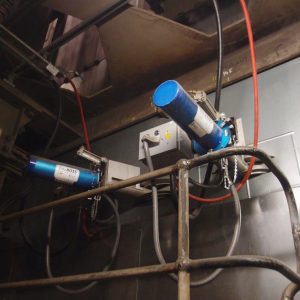
The SPPA-P3000 system does this by beaming an array of lasers across the inside of the boiler. “Lasers are used because different gases absorb light at different wavelengths,” explains Groganz. By collecting and analysing the data from either end of the lasers – specifically, which wavelengths have been absorbed during each beam’s journey across the boiler – it’s possible to identify areas within it burning fuel at different rates and potentially producing NOx emissions.

For example, some areas may be full of lots of unburnt particles, meaning there is a lack of air causing cold spots in the furnace. Other areas may be burning too hot, forcing together nitrogen and oxygen molecules into NOx molecules. The lasers detect these imbalances and give the system a clear understanding of what’s happening inside. But knowing this is only half the battle.

A breath of fresher air

“The next job is optimising the rate of burning within the boiler so fuel can be burnt more efficiently,” explains Groganz. This is achieved by selectively pumping air into the combustion process to areas where the combustion is too poor, or limiting air in areas which is too rich.

“If you limit the air being fed into air-rich, overheated areas, temperatures come down, which reduces the production of NOx gases,” says Groganz. “If you add air into air-poor, cooler areas, temperatures go up, burning the remaining particles of fuel more efficiently.”

Drax Laser 2

It’s a two-for-one deal: not only does balancing temperatures inside the boiler limit the production of NOx gases, but also improves the overall efficiency of the boiler, bringing costs down across the board. It even helps limit damage to the materials on the inside the boiler itself.

Thanks to this system, and thanks to its increased use of sustainable biomass (which naturally produces less NOx than coal), Drax has cut NOx emissions by 53% since the solution was installed. More than that, it is the first biomass power station to install a system of this sophistication at such scale. This means it is not just a feat of technical and engineering innovation, but one paving the way to a cleaner, more efficient future.

Half year results for the six months ended 30 June 2017

RNS Number : 4383L
Drax Group PLC
(Symbol: DRX)

Six months ended 30 June

H1 2017

H1 2016

Key financial performance measures

EBITDA (£ million)

121

70

Underlying earnings (£ million)

9

17

Underlying earnings per share (pence)

2.2

4.2

Total dividends (pence per share)

4.9

2.1

Net cash from operating activities (£ million)

197

151

Net debt (£ million)

372

85

Statutory accounting measures

(Loss) / profit before tax (£ million)

(83)

184

Reported basic (loss) / earnings per share (pence)

(17)

37


Financial and Operational Highlights

  • EBITDA of £121 million, an increase of £51 million on H1 2016
    • Strong operational performance
    • Improved earnings from renewable generation
    • Profitable and growing business to business (B2B) retail operation – Opus Energy and Haven Power
  • Statutory loss before tax includes unrealised losses related to foreign currency hedging of £65 million
  • Strong cash flows and balance sheet
    • Refinancing complete and capital allocation policy confirmed
  • Interim dividend of £20 million, representing 40% of the expected full year – £50 million

Strategic Highlights and Outlook

  • Focus on higher quality earnings with targeted investment in long-term growth opportunities
  • Good progress with strategic initiatives
    • Opus Energy and LaSalle Bioenergy acquisitions completed H1 2017, integration proceeding well
    • Focus on research and innovation, including development of options for future generation
  • Maintaining operational excellence across the Group
  • 2017 expectations unchanged, including c.2x net debt to EBITDA at year end

Dorothy Thompson, Chief Executive of Drax Group plc, said:

“We have made good progress with our strategy during the first half of 2017, acquiring Opus Energy and a third compressed wood pellet plant, in addition to refinancing and implementing a new dividend policy.

“Central to our strategy is the delivery of targeted growth through deploying our expertise across our markets and, in so doing, diversifying, growing and improving the quality of earnings whilst reducing exposure to commodity market volatility.

“Delivering reliable renewable electricity remains at the heart of our business. We continue to produce at record levels, helping to keep the UK’s electricity system secure and supplying our customers through our retail business. With the right conditions, we can do even more. We are progressing our four new rapid response gas power projects and our research and innovation work has identified potentially attractive options to repurpose our remaining coal assets.

“We continue to play a vital role in the UK’s energy infrastructure and our strategy is helping to change the way energy is generated, supplied and used for a better future.”

NOTES FOR ANALYSTS AND EDITORS

See: https://otp.tools.investis.com/clients/uk/drax1/rns/regulatory-story.aspx?cid=1607&newsid=892848

Directorate change – appointment of new non-executive director 

RNS Number : 4386L
Drax Group PLC
(Symbol: DRX)

David is Chief Executive of The Elders who he joined in October 2016.  The Elders is an independent group of global leaders working together for peace, justice and human rights, founded by Nelson Mandela in 2007.

Prior to that he was Chief Executive of the World Wide Fund for Nature UK (WWF-UK) from 2007 and chaired WWF’s Global Climate and Energy Initiative. He is also currently Non-Executive Chair of Transparency International UK, and a member of the Board of the International Integrated Reporting Council.

David originally qualified as a chartered accountant with Price Waterhouse, moved into venture capital with 3i, and then into manufacturing, latterly as Finance Director of Field Group plc through its management buyout and subsequent successful flotation in 1993. He joined Oxfam in 1997 as Finance Director and Deputy Chief Executive and was later seconded to head up Oxfam’s operations in India. In 2002 David joined Transparency International, the leading global anti-corruption organisation, as Chief Executive based in Berlin.

David has two degrees in theology, one in finance, and an honorary doctorate.

Commenting on the appointment Philip Cox, Chairman of Drax, said:  

“The directors are delighted to welcome David to the Board of Drax. His experience and expertise will be a valuable addition to the Board and will further help the successful delivery of our sustainability agenda.”

David Nussbaum added:

“The provision of sustainably generated power is crucial as we continue the transition to a low carbon future.  I look forward to joining the Board of Drax as the business develops, continuing to meet the challenges this presents, and make my contribution to it doing so successfully.”

David has also been appointed as a member of the Company’s Audit, Nominations and Remuneration Committees.

Notes to editors:

  • The Elders was founded by Nelson Mandela in 2007 following an initial proposal by Richard Branson and Peter Gabriel, and the current Chair is Kofi Annan. 
  • The Elders work collectively, combining private diplomacy with public advocacy to promote ethical leadership, defend human rights and amplify the voices of the downtrodden and marginalised.
  • The World Wide Fund for Nature (WWF) is an international non-governmental organisation founded in 1961, working to create a world where people and nature thrive within the means of our one planet.

Enquiries:

Drax Investor Relations: Mark Strafford

+44 (0) 1757 612 491

Media:

Drax External Communications: Paul Hodgson

+44 (0) 1757 612 026 

Website: www.drax.com

END


Chief Executive comments on half year results

We have made good progress with our strategy during the first half of 2017, acquiring Opus Energy and a third compressed wood pellet plant, in addition to refinancing and implementing a new dividend policy.

Central to our strategy is the delivery of targeted growth through deploying our expertise across our markets and, in so doing, diversifying, growing and improving the quality of earnings whilst reducing exposure to commodity market volatility.

Delivering reliable renewable electricity remains at the heart of our business. We continue to produce at record levels, helping to keep the UK’s electricity system secure and supplying our customers through our retail business. With the right conditions, we can do even more. We are progressing our four new rapid response gas power projects and our research and innovation work has identified potentially attractive options to repurpose our remaining coal assets.

We continue to play a vital role in the UK’s energy infrastructure and our strategy is helping to change the way energy is generated, supplied and used for a better future.

Related documents:


4 of the most exciting emerging technologies in electricity generation

Petri dish with microbe colony

Since the dawn of the industrial age, the world has been powered by a relatively small set of technologies. The 20th century was the age of coal, but this side of 2000, that’s changed.

The need to curb emissions and the rise of renewables, from wind to solar to biomass, has significantly changed how we fuel our power generation.

Today, some of the world’s most interesting and exciting emerging technologies are those designed to generate electricity.

Microbial fuel cells – harnessing the power of bacteria

Bacteria are all around us. Some are harmful, some are beneficial, but all of them ‘breathe’. When they breathe oxidation occurs, which is when something combines with oxygen at a chemical level, and when bacteria do this, electrons are released.

By connecting breathing microbes to a cathode and an anode (the positive and negative rods of a battery), the flow of these released electrons can be harnessed to generate power. This is what’s known as a microbial fuel cell (MFC). MFCs are used largely to generate electricity from waste water, but are expanding into more exotic uses, like powering miniature aquatic robots.

New developments are constantly expanding the power and applications of MFCs. Researchers at Binghamton University, New York found that combining phototropic (light-consuming) and heterotrophic (matter-consuming) bacteria in microbial fuel reactions generates currents 70 times more powerful than in conventional setups.

Building with sun shining through glass windows

Solar – a new dawn

Solar power may not be a new technology, but where it’s going is.

One of the most promising developments in the space is solar voltaic glass, which has the properties of a sheet of window glass but can also generate solar power.

Rather than collecting photons like normal solar does (and which transparent materials by definition can’t do) photovoltaic glass uses salts to absorb energy from non-visible wavelengths and deflects these to conventional solar cells embedded at the edge of each panel.

Or there’s solar PV paint, which contains tiny light sensitive particles coated with conductive materials. When layered over electrodes you’ve got a spray-on power generator.

Nuclear reactor hall in a power plant

Betavoltaics – nothing wasted from nuclear waste

Nuclear material is constantly decaying and in the process emits radioactive particles. This is why extremely radioactive material is so dangerous and why properly storing nuclear waste is so important and so expensive. But this waste can actually be put to good use. Betavoltaic devices use the waste particles produced by low-level radioactive materials to capture electrons and generate electricity.

The output from these devices can be fairly low and decreases over long periods of time, but because of the consistent output of nuclear decay they can be extremely long-lasting. For example, one betavoltaic battery could provide one watt of power continuously for 30 years.

And while they aren’t currently fit to work on a large scale, their longevity (and very compact size) make them ideal power sources for devices such as sensors installed on equipment that needs to be operational for long periods.

Ocean wave crashing at shore

Tidal power – changing tides

A more predictable power source than intermittent renewables like wind and solar, tidal power isn’t new, however its growth and development has typically been restrained by high costs and limited availability. That’s changing. Last year saw the launch of the first of 269 1.5 MW (megawatt) underwater turbines, part of world’s first large scale tidal energy farm in Scotland.

Around the world there are existing tidal power stations – such as the Sihwa Lake Tidal Power Station in South Korea, which has a capacity of 254MW – but the MeyGen array in Scotland will be able to take the potential of the technology further. It’s hoped that when fully operational it will generate 398MW, or enough to power 175,000 homes.

We might not know exactly how the electricity of tomorrow will be generated, but it’s likely some or all of these technologies will play a part. What is clear is that our energy is changing.