As more wind and solar power come online, the energy system is becoming more complex to manage. Supply is less predictable, demand is changing, and the need to balance both in real time is greater than ever.
In this discussion, Ross McKenzie brings together Drax CEO Will Gardiner, Chief Commercial Officer Paul Sheffield and Flexitricity CEO Andy Lowe to explore how optimisation is helping to meet that challenge.
Together, they unpack what optimisation means in practice, why it matters now, and how it can make energy systems more flexible, resilient and cost effective.
This article has been republished with permission from ESS News.
As shockwaves from the Iran war continue to ripple through global oil and gas markets, countries across Europe have experienced soaring energy prices. Here in the UK, the average consumer’s power bill price cap has already spiked 18% per year, while businesses are experiencing increases of up to 80%.
At the same time, Spain has been largely insulated from the same supply chain disruptions. Over the last six years, it has invested heavily in renewables – predominantly wind and solar – reducing the influence of fossil generators on its electricity price by 75% since 2019. Many renewables also offer a differentiated source of domestically produced power, which reinforces energy independence and security while hedging against single-source supply chain shocks.
This is yet another proof point that weather-dependent renewables are grid gamechangers, but it’s important to acknowledge that they cannot address all of the challenges we are trying to solve in the UK. We need to keep investing in the wider system.
A high-renewables grid: managing variability with flexibility
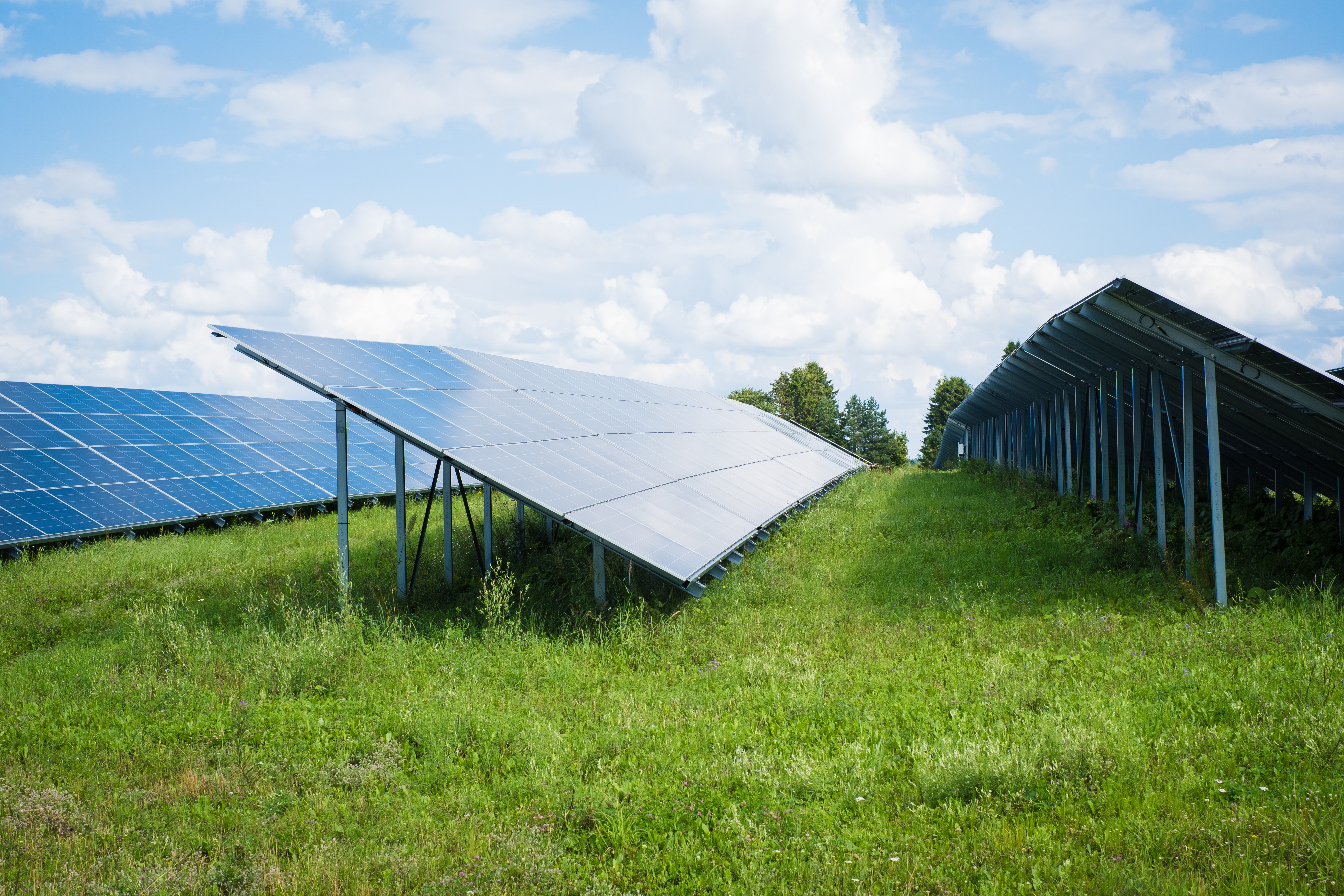
Not only do weather-dependent renewables support energy security, but they’re now cost competitive with fossil fuels. However, because intermittent renewables are dependent on external forces like wind and sunshine, they need complementary sources of flexibility to keep supply and demand balanced in real time to address:
Oversupply and curtailment. When the sun is shining and the wind is blowing at full force, energy generation sometimes exceeds demand and/or grid capacity limitations. As a result, the UK spends more than £1 billion annually on curtailment, where the government pays generators to reduce or turn off output during these periods.
Undersupply and “Dunkelflaute” risk. The weather patterns that hinder wind and solar often offset each other, but sometimes both can falter at the same time. This occurrence – referred to via the German term “Dunkelflaute” – is more likely to occur in the winter, resulting in supply drops right when demand to heat and power homes is at its highest.
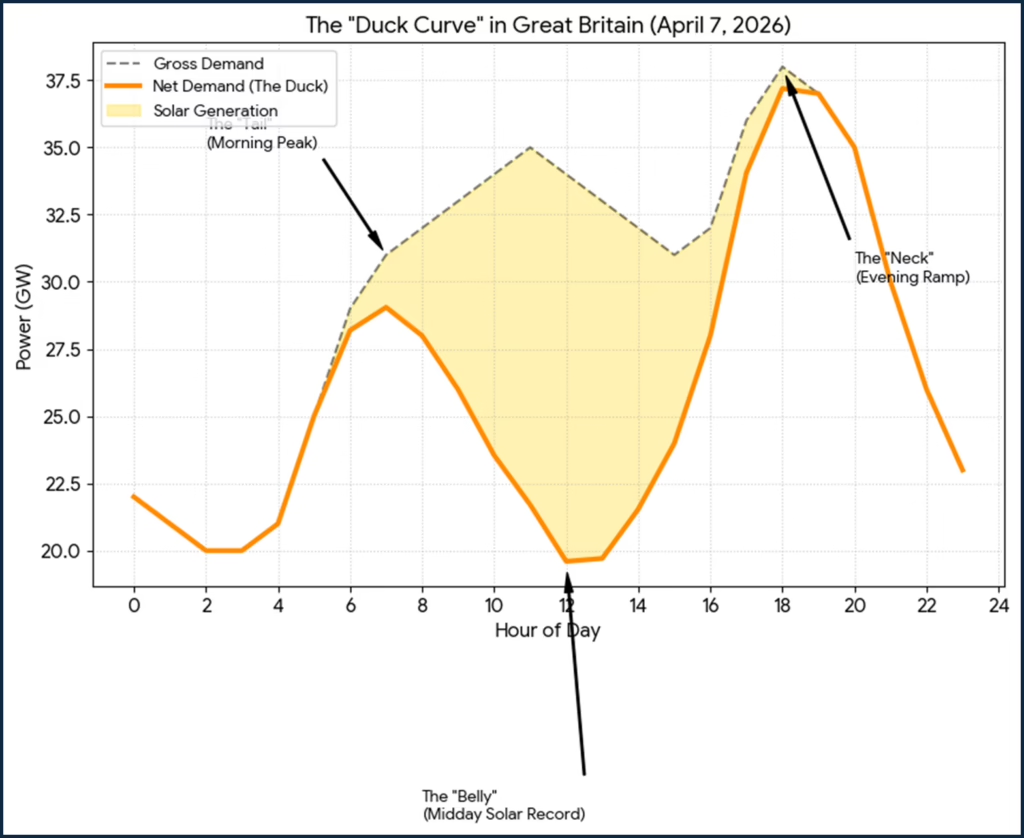
Day-to-day swings. In a typical day, intermittent renewables have periods of high and low production. At the same time, demand also has high and low periods. These supply low points often correlate with periods of high demand; for example, as solar generation falls away with the sunset, at-home lighting and appliance usage ramps up. This can result in grid strain and higher energy prices during the times when power is needed most but renewables are less available.
The “Duck Curve” is an industry term that refers to the shape created by the peaks and troughs of contrasting energy demand and intermittent renewable energy supply. The chart above visualizes the typical “duck” shape: a high morning peak (the tail), a deep midday dip (the belly) caused by record solar, and a steep evening ramp (the neck) as the sun sets and household demand spikes.
From national security to data security, the UK relies on consistent access to responsible, affordable power. Managing these swings is an integration challenge – not a reason to slow renewables. It’s a reason to accelerate the tools that make a high-renewables grid work to solve inefficiencies and unpredictability that can undermine the system, particularly during times of stress.
Balancing – not compensating for – intermittent volatility
Baseload generation is another key ingredient to stabilise the grid, helping to compensate for these supply swings. While this foundational support has traditionally been supplied through fossil fuels like coal, the UK has moved to more responsible alternatives like natural gas and sustainable biomass to anchor grid fluctuations.
Baseload generation supports grid stability, and weather dependent renewables are also essential but together they still cannot directly address when clean power is produced at the “wrong” time or the “wrong” place. This is where energy storage steps in.
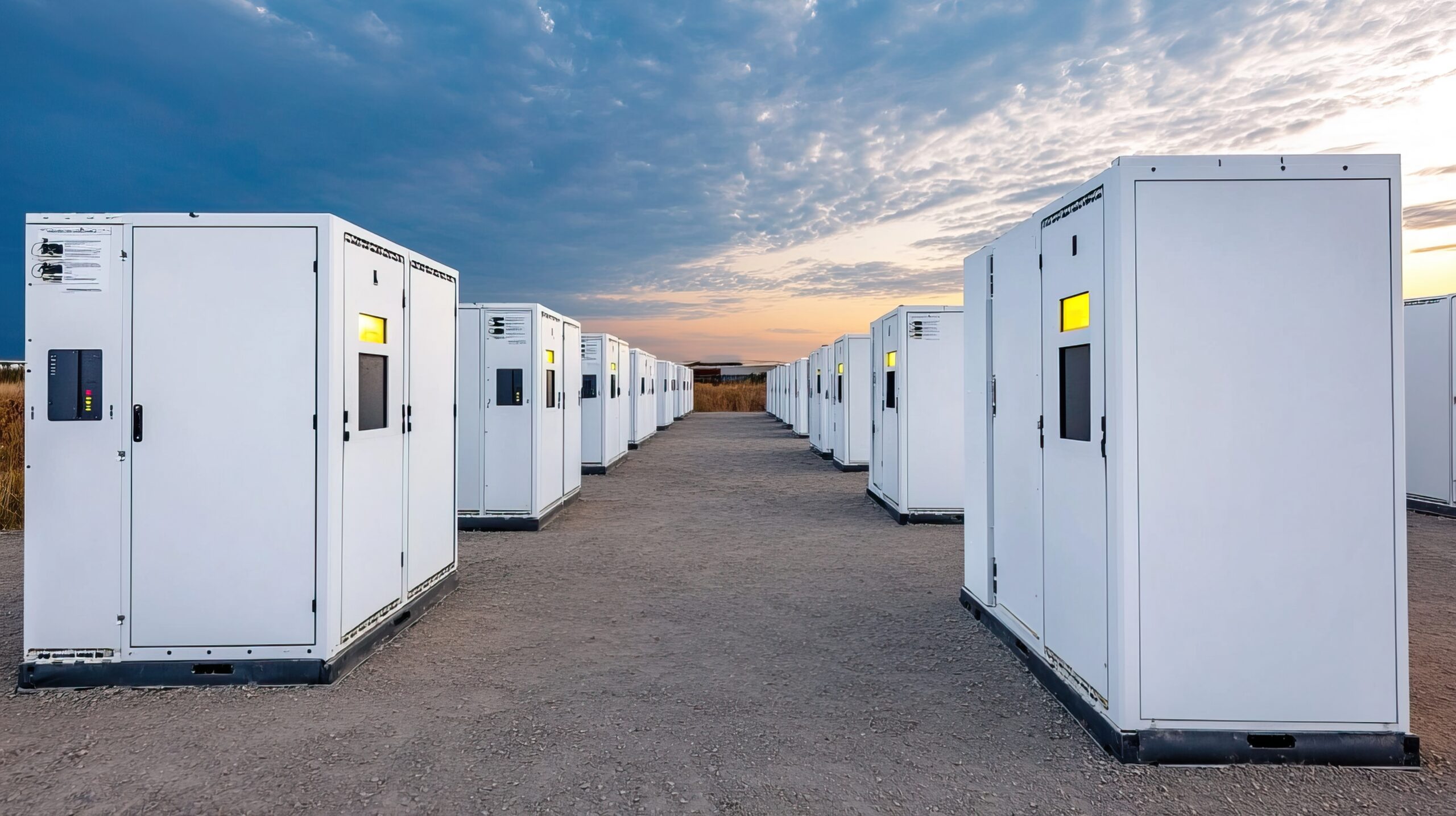
Energy storage, including batteries, pumped hydro, thermal, and chemical solutions, complements intermittent power generation. These technologies can capture excess clean energy when generation is high and deploy it when supply is low, balancing supply and demand and helping flatten the duck curve. Energy storage solutions can extend the benefits of clean power generation and supply, meeting peak demand even when they’re not actively generating power, all while reducing reliance on baseload generation.
Looking to the future, long-duration energy storage (LDES) batteries also have a key role to play. Current economic and market structures favour lithium-ion-based short-term batteries, but it’s only a matter of time until long-term battery technologies become more efficient and affordable, and the rate of adoption is expected to grow exponentially as a result.
Recent geopolitical conflicts have reiterated the importance of a diversified, balanced energy system. Nations that adapt toward a system built on flexible generation and storage – designed to deliver reliability, affordability, and sustainability while insulating against future shocks – will have a clear advantage, both today and in years to come. We believe there is no better time than now to bet on batteries as part of the UK’s evolution to a more flexible energy system.
During the last bank holiday weekend, as Britain basked in the sunshine, the national grid quietly made history. Demand plummeted to an all-time low of just 12.6GW – roughly the average daily demand of the Philippines. This was nearly four times less than we consumed on a cold, dark Thursday evening in January when the nation cranked up the heating and turned on the kettle.
Seasonal demand swings are nothing new, and for decades have proved a rule that traditional, dispatchable assets like Drax Power Station are the backbone of our energy security. But in this week of warm weather and unprecedented low demand, solar has generated as much as half of the power Britain consumed – an unthinkable achievement ten years ago.
Intermittent wind and solar, battery storage, electric vehicles and AI are changing our energy system profoundly and in real time. How government, the system operator and companies like Drax manage this change can be measured not in the millions but in the billions of pounds of difference to the British economy every year.
At Drax our mission has always been to deliver what the country needs. For over sixty years, our assets have provided secure electricity to millions of the UK’s households and businesses. When climate change became a national imperative, we did what many thought impossible and transformed Western Europe’s largest coal fired power station into Britain’s largest single source of renewable electricity. Today, we are once more investing to deliver in the national interest.
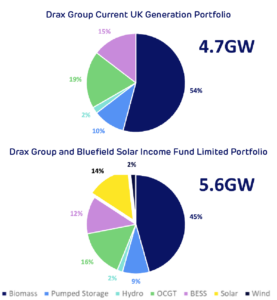
Our recommended offer for Bluefield Solar Income Fund is a key moment for our business and its next phase. This would be the largest deal in our history, and with BESS and OCGT development sites included, our renewable generation business and flexible generation assets combined will have a larger power capacity of over 3GW than Drax Power Station’s 2.6GW for the first time.
Potentially adding around 900MW of solar and wind with another 2.9GW pipeline of development, including JVs, into the Drax portfolio could mean we are able to keep the lights on whether it is a baking hot bank holiday or a damp and dreary January. And critically the cost of power generated by solar and wind is not impacted by the ongoing situation in the Strait of Hormuz.
We’re building a diverse portfolio of hydro, batteries, gas, and now potentially wind and solar alongside a trading capability that will enable us to help deliver the UK’s energy security efficiently and affordably. We’re proud to have been at the heart of Britain’s energy system for sixty years, and we’re investing in and evolving our business now to ensure we continue to deliver what the country needs for decades to come.
RNS Number: 1217G Drax Group plc (“Drax” or the “Company”; Symbol:DRX)
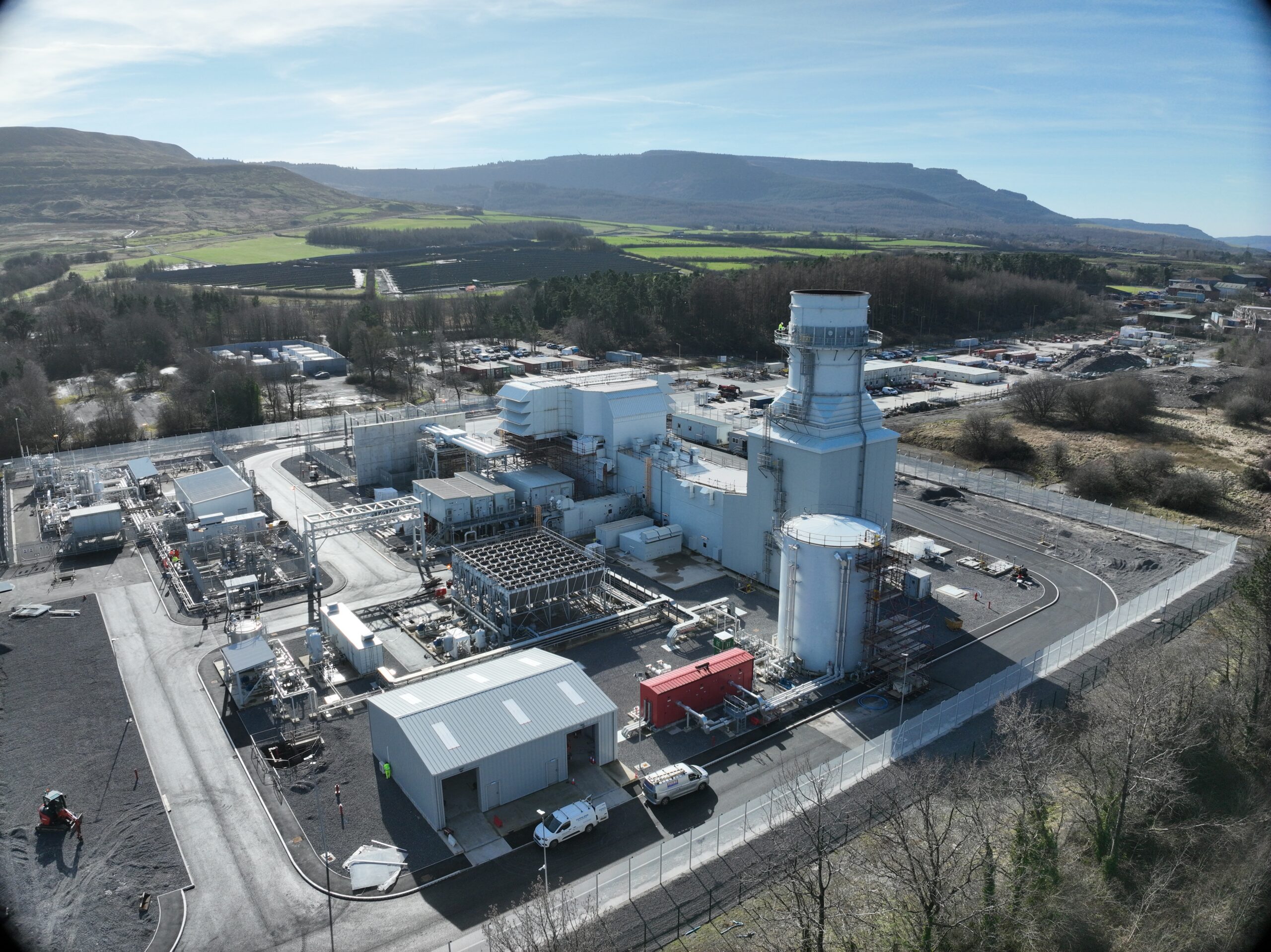
Drax is pleased to announce that commissioning of Hirwaun Power Station is now complete and Drax has assumed commercial control from the developer Metlen Energy & Metals. Hirwaun, which is located in South Wales, is the first of three 299MW Open Cycle Gas Turbine (OCGT) plants which Drax is developing in England and Wales.
Drax Group CEO, Will Gardiner, said: “The successful commissioning of our first OCGT plant is a landmark moment for Drax.
“The energy transition is creating opportunities for us to invest and grow our business in line with the country’s energy needs. Alongside our OCGT developments, we have made initial investments in Battery Energy Storage Systems (BESS), which we see as an attractive market. We are continuing to explore options to invest in flexible and renewable energy, supporting energy security, creating value for stakeholders and attractive returns for shareholders in line with our capital allocation policy.”
The three OCGTs combined will provide capacity of c.900MW when fully commissioned and be remunerated via a combination of peak power generation, system support services, and long-term index-linked Capacity Market agreements. These Capacity Market agreements extend to 2039 and are worth over £260 million in revenue.
The sites benefit from a low fixed cost base with operation and dispatch managed centrally by Drax and day-to-day management of the sites by Siemens Energy.
Power generation and system support capabilities
The flexibility of OCGTs allows them to switch on and off quickly to meet periods of high demand, which supports the increased use of intermittent renewables across the UK system, supporting energy security, with a reduced dependence on fossil fuels and a reduction in net carbon emissions.
In addition, the OCGTs have been built with a clutch mechanism between the turbine and generator, allowing for them to operate as a Synchronous Compensator, which can provide additional non-generation services, such as inertia and voltage control, without engaging the gas turbine.
With the evolution of the UK market, continued roll out of renewables and an increased focus on energy security, Drax believe that demand for and value of these types of services will increase.