
Tag: flexibility

Why the energy transition demands a new playbook

During the last bank holiday weekend, as Britain basked in the sunshine, the national grid quietly made history. Demand plummeted to an all-time low of just 12.6GW – roughly the average daily demand of the Philippines. This was nearly four times less than we consumed on a cold, dark Thursday evening in January when the nation cranked up the heating and turned on the kettle. 

Seasonal demand swings are nothing new, and for decades have proved a rule that traditional, dispatchable assets like Drax Power Station are the backbone of our energy security. But in this week of warm weather and unprecedented low demand, solar has generated as much as half of the power Britain consumed – an unthinkable achievement ten years ago.  

Intermittent wind and solar, battery storage, electric vehicles and AI are changing our energy system profoundly and in real time. How government, the system operator and companies like Drax manage this change can be measured not in the millions but in the billions of pounds of difference to the British economy every year.  

At Drax our mission has always been to deliver what the country needs. For over sixty years, our assets have provided secure electricity to millions of the UK’s households and businesses. When climate change became a national imperative, we did what many thought impossible and transformed Western Europe’s largest coal fired power station into Britain’s largest single source of renewable electricity. Today, we are once more investing to deliver in the national interest. 

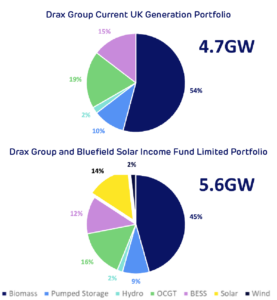
Our recommended offer for Bluefield Solar Income Fund is a key moment for our business and its next phase. This would be the largest deal in our history, and with BESS and OCGT development sites included, our renewable generation business and flexible generation assets combined will have a larger power capacity of over 3GW than Drax Power Station’s 2.6GW for the first time.

Potentially adding around 900MW of solar and wind with another 2.9GW pipeline of development, including JVs, into the Drax portfolio could mean we are able to keep the lights on whether it is a baking hot bank holiday or a damp and dreary January. And critically the cost of power generated by solar and wind is not impacted by the ongoing situation in the Strait of Hormuz. 

We’re building a diverse portfolio of hydro, batteries, gas, and now potentially wind and solar alongside a trading capability that will enable us to help deliver the UK’s energy security efficiently and affordably. We’re proud to have been at the heart of Britain’s energy system for sixty years, and we’re investing in and evolving our business now to ensure we continue to deliver what the country needs for decades to come. 

Please find the full announcement of the recommended acquisition of BSIF through the following link: https://polaris.brighterir.com/public/drax_group/news/rns/story/r7kk2zw

Demand Side Flexibility gets a winter boost

The Government’s Clean Power 2030 Action Plan and Clean Flexibility Roadmap established demand-side flexibility (DSF) as an essential component of the transition to a smarter, more flexible energy system. The Action Plan targets 10-12GW of DSF from a range of different sources by 2030, supported by actions outlined in the Roadmap.

Several updates in December 2025 reveal strong progress towards a more flexible future.

DSF Routes to Markets Review

In December, the National Energy System Operator (NESO) published its Demand-Side Flexibility Routes to Markets Review. The report highlighted progress against identified barriers for DSF participants accessing NESO flexibility services and proposed reforms to the Demand Flexibility Service (DFS). These reforms included introducing demand turn-up, locational procurement and reducing minimum unit size to 0.1MW.

NESO also announced an update to the operational metering requirements for <1MW aggregated assets within the balancing mechanism (BM). It plans to relax accuracy, refresh rate and latency requirements in early 2026 to make the BM more accessible to small scale aggregated assets.

NESO targets 750MW of I&C DSF

Following on from the Routes to Market Review, NESO set a target to add 750MW of additional industrial and commercial (I&C) flexibility to its markets by 2030. NESO’s target is for demand turn-down only and excludes transport and embedded generation. The target is designed to support the Clean Power 2030 (CP30) ambition of 1.7GW of I&C DSF by 2030, more than doubling 2024 levels.

Wider NESO actions support DSF

In its market update, NESO announced the establishment of a dedicated onboarding team for non-domestic providers to support large end consumers in accessing flexibility markets. It also extended the Local Constraints Market (LCM) until January 2027, having seen growth in demand-side participation. NESO attribute this growth to including a progressive asset metering approach, no minimum MW participation threshold, and changes to support aggregator participation.

Market Facilitator

Elexon’s role as Market Facilitator went live on 12 December 2025. As such, it will coordinate local and national flexibility market arrangements to enhance liquidity and reduce friction. It’s already established 10 market rules applicable to District Network Operator (DNO) and NESO markets, to be implemented at various points during 2026. Elexon intends to improve standardisation in matters such as carbon reporting, end-to-end processes, product definitions, prequalification for accessing markets, and primacy between different services.

Drax agrees Flexitricity purchase

Drax Energy Solutions is a decarbonisation partner for many I&C businesses across Great Britain. We support our customers in accessing revenues for flexibility, and were the largest I&C supplier in NESO’s DFS for the first two winters cumulatively. On 21 January 2026, Drax Group announced an agreement to acquire Flexitricity, a UK-based optimiser of flexible energy assets.

Founded in 2004, Flexitricity provides – via a proprietary controls platform – optimisation and route-to-market services to owners of flexible energy assets. This enables those owners to participate in the wholesale energy, balancing and ancillary services markets. Aligning the scalable platform and optimisation expertise of Flexitricity with the trading and supply expertise of Drax Group is expected to bring benefits to the customers of both companies.

We expect to complete the acquisition, which is conditional on the completion of regulatory approvals and processes, in Q1 2026.

Disclaimer: We’ve used all reasonable efforts to ensure that the content in this article is accurate, current, and complete at the date of publication. However, we make no express or implied representations or warranties regarding its accuracy, currency or completeness. We cannot accept any responsibility (to the extent permitted by law) for any loss arising directly or indirectly from the use of any content in this article, or any action taken in relying upon it.


Flexibility Focus looks at a more responsive and decentralised GB power system

Q4 2025 established new rules, targets and obligations for a more responsive and decentralised GB power system. The National Energy System Operator (NESO) set a clear ambition to unlock an additional 750MW of industrial and commercial (I&C) flexibility by 2030, reinforcing the growing role of consumer-led flexibility in supporting Clean Power 2030.

Wholesale markets were shaped by volatile wind output and mild winter temperatures. While average prices remained relatively stable, periods of low wind and high demand pushed prices above £200/MWh on three occasions, strengthening the business case for flexibility and peak demand shifting. Delivered cost arbitrage opportunities were significantly higher than in Q3 due to the application of winter third party costs. Consumers on pass-through contracts could have been able to save over £380/MWh by shifting demand from peak periods.

The Demand Flexibility Service (DFS) saw lower volumes than Q3, driven largely by mild weather and reduced system stress. However, activity shifted later into the evening peak, reflecting changing demand patterns and seasonal drops in solar generation. NESO also confirmed upcoming reforms, including demand turn-up, locational procurement, sub-1MW bids, and improved baselining for variable assets – all expected to widen participation.

On the policy and regulation side, Elexon’s new Market Facilitator role went live, introducing standardised rules designed to reduce barriers to entry across flexibility markets. Meanwhile, the upcoming launch of Slow Reserve in March 2026 will replace STOR, with more accessible thresholds and improved routes for demand-side response providers.

Looking ahead to Q1 2026, the market awaits key decisions on Capacity Market reforms, and further announcements as part of the Review of the Electricity Market Arrangements (REMA) programme, including updates to balancing reform – all of which will shape the next phase of flexibility growth.

At Drax Energy Solutions, the announced agreement to acquire Flexitricity will, once complete, strengthen our ability to help customers unlock greater value from their flexible assets and participate across an expanding range of markets.

Read the full Flexibility Focus report for detailed market analysis, policy updates and revenue insights here

Disclaimer: We’ve used all reasonable efforts to ensure that the content in this article is accurate, current, and complete at the date of publication. However, we make no express or implied representations or warranties regarding its accuracy, currency or completeness. We cannot accept any responsibility (to the extent permitted by law) for any loss arising directly or indirectly from the use of any content in this article, or any action taken in relying upon it.