





Tag: power generation

Demand Side Flexibility gets a winter boost

The Government’s Clean Power 2030 Action Plan and Clean Flexibility Roadmap established demand-side flexibility (DSF) as an essential component of the transition to a smarter, more flexible energy system. The Action Plan targets 10-12GW of DSF from a range of different sources by 2030, supported by actions outlined in the Roadmap.

Several updates in December 2025 reveal strong progress towards a more flexible future.

DSF Routes to Markets Review

In December, the National Energy System Operator (NESO) published its Demand-Side Flexibility Routes to Markets Review. The report highlighted progress against identified barriers for DSF participants accessing NESO flexibility services and proposed reforms to the Demand Flexibility Service (DFS). These reforms included introducing demand turn-up, locational procurement and reducing minimum unit size to 0.1MW.

NESO also announced an update to the operational metering requirements for <1MW aggregated assets within the balancing mechanism (BM). It plans to relax accuracy, refresh rate and latency requirements in early 2026 to make the BM more accessible to small scale aggregated assets.

NESO targets 750MW of I&C DSF

Following on from the Routes to Market Review, NESO set a target to add 750MW of additional industrial and commercial (I&C) flexibility to its markets by 2030. NESO’s target is for demand turn-down only and excludes transport and embedded generation. The target is designed to support the Clean Power 2030 (CP30) ambition of 1.7GW of I&C DSF by 2030, more than doubling 2024 levels.

Wider NESO actions support DSF

In its market update, NESO announced the establishment of a dedicated onboarding team for non-domestic providers to support large end consumers in accessing flexibility markets. It also extended the Local Constraints Market (LCM) until January 2027, having seen growth in demand-side participation. NESO attribute this growth to including a progressive asset metering approach, no minimum MW participation threshold, and changes to support aggregator participation.

Market Facilitator

Elexon’s role as Market Facilitator went live on 12 December 2025. As such, it will coordinate local and national flexibility market arrangements to enhance liquidity and reduce friction. It’s already established 10 market rules applicable to District Network Operator (DNO) and NESO markets, to be implemented at various points during 2026. Elexon intends to improve standardisation in matters such as carbon reporting, end-to-end processes, product definitions, prequalification for accessing markets, and primacy between different services.

Drax agrees Flexitricity purchase

Drax Energy Solutions is a decarbonisation partner for many I&C businesses across Great Britain. We support our customers in accessing revenues for flexibility, and were the largest I&C supplier in NESO’s DFS for the first two winters cumulatively. On 21 January 2026, Drax Group announced an agreement to acquire Flexitricity, a UK-based optimiser of flexible energy assets.

Founded in 2004, Flexitricity provides – via a proprietary controls platform – optimisation and route-to-market services to owners of flexible energy assets. This enables those owners to participate in the wholesale energy, balancing and ancillary services markets. Aligning the scalable platform and optimisation expertise of Flexitricity with the trading and supply expertise of Drax Group is expected to bring benefits to the customers of both companies.

We expect to complete the acquisition, which is conditional on the completion of regulatory approvals and processes, in Q1 2026.

Disclaimer: We’ve used all reasonable efforts to ensure that the content in this article is accurate, current, and complete at the date of publication. However, we make no express or implied representations or warranties regarding its accuracy, currency or completeness. We cannot accept any responsibility (to the extent permitted by law) for any loss arising directly or indirectly from the use of any content in this article, or any action taken in relying upon it.
Flexibility Focus looks at a more responsive and decentralised GB power system

Q4 2025 established new rules, targets and obligations for a more responsive and decentralised GB power system. The National Energy System Operator (NESO) set a clear ambition to unlock an additional 750MW of industrial and commercial (I&C) flexibility by 2030, reinforcing the growing role of consumer-led flexibility in supporting Clean Power 2030.

Wholesale markets were shaped by volatile wind output and mild winter temperatures. While average prices remained relatively stable, periods of low wind and high demand pushed prices above £200/MWh on three occasions, strengthening the business case for flexibility and peak demand shifting. Delivered cost arbitrage opportunities were significantly higher than in Q3 due to the application of winter third party costs. Consumers on pass-through contracts could have been able to save over £380/MWh by shifting demand from peak periods.

The Demand Flexibility Service (DFS) saw lower volumes than Q3, driven largely by mild weather and reduced system stress. However, activity shifted later into the evening peak, reflecting changing demand patterns and seasonal drops in solar generation. NESO also confirmed upcoming reforms, including demand turn-up, locational procurement, sub-1MW bids, and improved baselining for variable assets – all expected to widen participation.

On the policy and regulation side, Elexon’s new Market Facilitator role went live, introducing standardised rules designed to reduce barriers to entry across flexibility markets. Meanwhile, the upcoming launch of Slow Reserve in March 2026 will replace STOR, with more accessible thresholds and improved routes for demand-side response providers.

Looking ahead to Q1 2026, the market awaits key decisions on Capacity Market reforms, and further announcements as part of the Review of the Electricity Market Arrangements (REMA) programme, including updates to balancing reform – all of which will shape the next phase of flexibility growth.

At Drax Energy Solutions, the announced agreement to acquire Flexitricity will, once complete, strengthen our ability to help customers unlock greater value from their flexible assets and participate across an expanding range of markets.

Read the full Flexibility Focus report for detailed market analysis, policy updates and revenue insights here

Disclaimer: We’ve used all reasonable efforts to ensure that the content in this article is accurate, current, and complete at the date of publication. However, we make no express or implied representations or warranties regarding its accuracy, currency or completeness. We cannot accept any responsibility (to the extent permitted by law) for any loss arising directly or indirectly from the use of any content in this article, or any action taken in relying upon it.

Price matters – lowering the cost of the energy transition

  • Analysis by Baringa shows that Drax Power Station, operating under a new low-carbon dispatchable CfD, will lower the costs of the UK clean energy transition between 2027 and 2031 by £1.6 to 3.1bn, compared with a scenario without Drax.
  • When there isn’t enough electricity from weather dependent renewables to meet demand, Drax will step in to increase generation.
  • This brings down the amount of costly ‘standby’ capacity the Government needs to buy on the capacity market to avoid shortages
  • It also makes the UK less reliant on gas and imports via interconnectors, reducing the upwards influence they have on the wholesale cost of energy.
  • By displacing gas, Drax will reduce emissions from the electricity sector by approximately 4 MtCO2 between 2027 and 2031 – equivalent to taking 1.5 million diesel or petrol cars off the road.   

Over the next six years, the UK will increasingly rely on electricity generated by intermittent renewables and, by 2030, wind and solar will provide the majority of our electricity.

Drax Power Station will play an essential supporting role, stepping up generation when windless, gloomy weather causes wind and solar output to drop, and stepping down again to balance the grid when the weather changes.

As a clean energy source, its flexibility to do this is rare. Nuclear, for instance, provides a steady flow of clean electricity, but it can’t be turned up and down in the same way Drax’s biomass generation units can.

The Government has designed a new low carbon dispatchable CfD to support Drax’s flexible generation between 2027 and 2031.

Analysis by Baringa shows that this lowers the costs of the clean energy transition between 2027 and 2031 by between £1.6 – 3.1bn. There are two major factors in this: lower capacity market costs and Drax’s impact on the wholesale costs of electricity. These are explained in more detail below.

Reduced capacity market payments

The capacity market is colloquially referred to as the UK’s black out prevention system. It works by paying some energy generators to have extra ‘standby’ capacity available, which can then be drawn on when there is a shortage of electricity.

Prices in the capacity market vary from year to year and are affected by the amount of existing guaranteed capacity in the market – the more that there is, the less that needs to be procured in the capacity market, and the lower the price.

Drax Power Station provides 2.6GW of capacity. That’s more than any other single source in the UK and more than double the capacity of the average gas power station. It’s also more than the combined capacity of the UK’s two largest operational nuclear power stations – Heysham 2 and Torness (2.4 GW). *

Having it on the system brings down prices in the capacity market as the Government needs to purchase less capacity. Baringa estimate that this saves the UK between £640m and £1bn from 2027 to 2031.

Reduced wholesale energy cost

Electricity generated at Drax Power Station will make the UK less reliant on gas and interconnector imports. Both are typically expensive, particularly in the winter months when high demand in the UK and Europe, as well as Asia, pushes up prices.

For instance, when the UK was hit with a period of cold, gloomy windless weather in early January, demand increased as supply from wind and solar plummeted and the UK called on additional gas and imports to fill the gap. Power prices briefly surged to £2,900/MWh (40 times their average) as a result.

Research by Baringa estimates that Drax Power Station will reduce gas generation by around 4.3% and imports by almost 4.9%. This brings down the wholesale electricity price, saving £1.8bn compared to a counterfactual scenario without Drax, and potentially more if the price of gas is higher than anticipated.

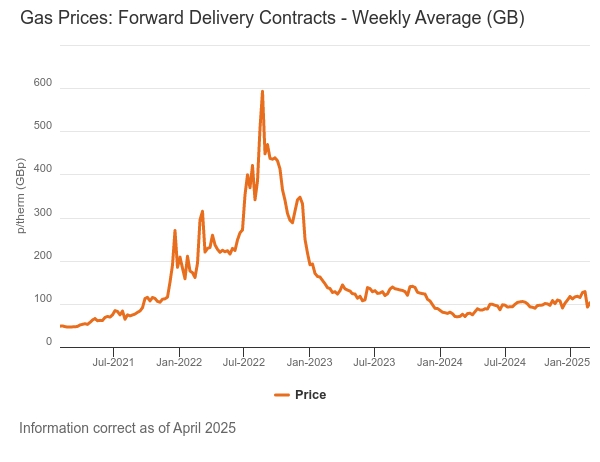
Drax Power Station also reduces the UK’s exposure to ongoing price volatility in these markets, which influences the wholesale prices of energy in the UK on an ongoing basis. For example, the price of gas shot up by 130% when Russia invaded Ukraine in 2022 and, as the graph below shows, it continues to fluctuate.

Displacing gas reduces fossil fuel use and cuts carbon

Displacing gas not only has a price benefit, it lowers fossil fuel use. In the case of the low-carbon, dispatchable CfD with Drax, reducing emissions from the energy sector by 1 million tonnes CO2e per year (4 MtCO2e over the course of the four-year term). This equates to c.5% of total power sector emissions and is equivalent to taking 1.5 million diesel or petrol cars off the road.

Overall, as the UK moves to a clean energy system, Drax makes sense for consumers and the climate. Beyond 2030 there is also the potential to add carbon capture and storage technology to Drax Power Station, converting it to BECCS. This could create the world’s largest carbon removal facility; saving the UK £15bn on its path to net zero and helping position us at the leading edge of an exciting new technology area that will be critical to meeting global climate targets.

Report: ‘Value for money assessment of the low carbon dispatchable CfD for Drax Power Station’, Baringa (2025) can be read in full here


Wind droughts show the need for low-carbon flexible generation

By Dr Iain Staffell, Imperial College London 

As our energy mix changes and a different weather challenge has been taking up the headlines, latest analysis from Electric Insights has revealed that the need for reliable low-carbon generation when the wind doesn’t blow and the sun doesn’t shine is becoming more important. Dr Iain Staffell took a look at the data.   

“Dunkelflaute” must surely be an early contender for the 2025 Oxford Dictionary word of the year.  A German word meaning “dark doldrums”, it is used in the energy world to describe a dark, cold, calm spell of weather during which very little energy can be generated with wind or solar power.

In December and January, Britain has faced two spells of so-called Dunkelflaute.  The first, hitting around the 12 December, saw wind – the largest source of energy in the UK last year overall – drop to 6% of total supply.  In response, gas power stations ramped up to their highest output ever recorded, supplying more than 73% of Britain’s electricity and sending power prices soaring.  Wind output dropped suddenly again in the New Year causing prices to hit £2,900/MWh (40 times their average) on 8 January.

This winter has again demonstrated some of the challenges we must address in reaching a clean power system by 2030.  The combination of a long cold snap and low wind speeds left Britain’s power system relying heavily on natural gas and imports, drawing down the nation’s gas storage to ‘concerningly low’ levels, and coming close to generation falling short of peak demand.  Options for low-carbon flexibility are urgently needed – both investing in new technologies and maintaining existing sources – as electricity supply and demand become more dependent on the weather.

Daily average electricity mix in Britain during mid-December, highlighting the Dunkelflaute period, and the difference between output from dispatchable technologies which we control, and those that are driven by the weather or foreign power markets.

Gas was not the only technology to help during the shortfall.  Biomass and hydro plants increased their output by 40% and 60% on the peak day (12 December) compared to the weekends before and after.  While this helped meet the shortfall of wind, the impact was muted as Britain has relatively little capacity of either technology.  In previous years, coal power stations would have also helped to meet demand, but the last one closed in September.  Pumped hydro and batteries helped meet the evening peak on the 12th, but these only supply power for a few hours, and so cannot help with multi-day shortages.

Interconnection with neighbouring countries also provides flexibility, but on the 12th when we most needed them, imports from abroad fell by half relative to the surrounding days.  Britain’s neighbours were suffering from the same wind drought, as weather systems are often the size of continents.  More power could have flowed into Britain, but only if our prices rose high enough.  This exposes a key problem with relying on interconnection to solve capacity shortages, which leaves countries competing for limited supply of power at the same time.

Altogether, this leaves gas as the only large-scale source of flexibility in the country.  This is a risky proposition on three fronts: affordability, energy security, and our climate goals.

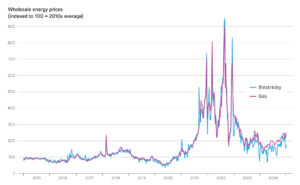
The cost of our gas dependence: We are still reeling from the gas price crisis.  Gas is very much the ‘crutch’ of the grid, and British electricity is more strongly swayed by gas prices than in any other European country, as we have so few alternatives for flexible generation (no coal, limited hydro and biomass, and less storage than neighbouring countries).  Gas sets the electricity price in 98% of hours, despite meeting only a third of electricity demand. That means Britain’s electricity prices track almost perfectly with gas prices, leaving consumers particularly vulnerable to price shocks, as seen during the recent gas price crisis.

The change in electricity and natural gas prices on Britain’s wholesale markets over the last decade, indexed to the 2010–19 average.  Gas prices increased by over 50% between February and December last year, dragging electricity prices up with them.

Energy security at risk: Relying so heavily on a single technology in times of system stress is leaving all our eggs in one basket.  Capacity was tight on 12 December and 8 January, causing NESO to issue rare Capacity Market Notices, a ‘blackout prevention system’ used to encourage generators to prepare extra capacity just in case.   Britain’s last coal plant has retired, all bar one nuclear plant is coming towards their end of life, and it is unclear if biomass will continue operating beyond 2027.  This all comes just as peak electricity demand is expected to grow from electric vehicles, heat pumps, AI, and data centres.  Unless more capacity is built or existing capacity has its lifetime extended, Capacity Market Notices will be increasingly likely in future.

The carbon challenge: Gas is the most polluting fuel remaining on the grid.  In just five years, government aim to run a clean power system, meaning just 5% of electricity produced from fossil fuels, down from over 25% today.  These plans include retaining almost all the current gas capacity to cover rare but intense periods of low renewable output.  Put together, this means gas plants will see fewer operating hours in the future, just as coal plants did over the last decade.  Either they will need to charge more for their output to cover costs, or the system needs to move more towards paying for availability than for output (e.g. capacity payments).

Phasing out gas will largely be achieved by scaling up wind and solar power, but that further intensifies the challenges posed by weather variability.  Both the CCC and NESO recognise that a balanced approach is needed, using all the tools at our disposal – flexible low-carbon generation, long-duration energy storage, interconnectors and a continued (but increasingly limited) role for gas.  Looking ahead, policy frameworks envisage the arrival of more low-carbon dispatchable power from 2030 onward.  This includes power stations equipped with carbon capture and storage (CCS), hydrogen, and long-duration storage.  All of these play little or no role in today’s power system, so the task now is to define a clear strategy for scaling and deploying these resources at pace, while avoiding cost escalation to consumers due to all the new investments.  By planning for Britain’s future energy needs and taking strategic action now, government, industry and investors can break free from paying for volatile gas expensive imports, and seize the opportunity of clean, stable, and lower cost electricity.

Read the full article here or in the Q4 2024 Electric Insights report, coming soon.

This article was written by Dr Iain Staffell, Senior Lecturer at Imperial College London, as part of the Electric Insights project. Drax does not guarantee the accuracy, reliability or completeness of this content.