





Archives: Press Release

Analysis: development of BECCS at Drax Power Station projected to save UK £15bn and offset carbon emissions equivalent to all departing flights from Heathrow

Drax Power Station cooling towers
  • Cost savings from carbon removals from BECCS at Drax are projected to be equivalent to £700m per year from 2030 to 2050, compared to other more complex carbon reduction measures
  • Annual amount of carbon captured by the project would be equivalent to taking 3 million cars off the road or cancelling all annual departing flights from Heathrow
  • BECCS at Drax is believed to be the only credible, large-scale carbon removals option that could deliver energy security and support the UK’s 2030 Greenhouse Gas Removals target
  • A bridging mechanism, a key enabler of BECCS, applied prior to the start of BECCS operations could save billions particularly if gas prices spike

New analysis by Baringa and commissioned by Drax Group (Drax) – The Value of BECCS at Drax Power Station – finds that Drax’s proposals for bioenergy with carbon capture and storage (BECCS) could save the UK up to £15bn in whole economy costs between 2030 and 2050.

This saving is equivalent to around £700m per annum, or £25 per household per year, and could help provide a more efficient pathway to meeting the UK’s Net Zero targets.

BECCS is currently the only credible technology that can create carbon removals while also supporting UK energy security by generating renewable electricity. Drax could initially convert two of its generating units to the technology at its North Yorkshire site.

Baringa’s findings demonstrate that without BECCS at Drax, meeting carbon reduction targets is more complicated and expensive for the UK Government and carbon savings would be needed in other sectors. Including, for example, investment in synthetic natural gas production facilities costing £8.5bn, committing to 735,000 more heat pumps beyond existing stretch targets, costing £5bn, amongst other measures.

Will Gardiner, CEO Drax Group, said:

“Climate change is the greatest challenge we face and the UK needs to use every option available to reduce carbon emissions and reach Net Zero as urgently as possible.

“This research shows BECCS at Drax Power Station offers the most cost-effective, straightforward and efficient way to help the country meet climate targets and could save billions of pounds, remove millions of tonnes of carbon from the atmosphere and support the UK’s energy security.

“To hit the UK’s annual carbon removal target, we need to build BECCS at Drax Power Station. Policy support for deploying BECCS grew in 2023, including the publication of the Biomass Strategy, and we believe that we will see the launch of a consultation on the bridging mechanism shortly.”

With around 7 GW of nuclear and coal capacity expected to close between 2024 and 2030, and growing uncertainty around timelines for new nuclear deployment, Baringa’s research underscores the critical role of Drax in delivering both cost effective energy security today and following potential BECCS conversion, in the future. The power station generates around 4% of the country’s power and 9% of its renewable electricity by output1.

The report also shows that the implementation of a bridging mechanism between the end of Drax’s renewable contracts in 2027 and the potential start of BECCS operations could save around £2bn over the period, if gas prices remained similar to the current winter period. This is the equivalent to reducing each UK household’s yearly energy bills by £5. Under Baringa’s model, if gas prices spiked over one winter period, as they did in 2021/22, then the mechanism could save households around £3.5bn in one winter period alone.

Drax investment in UK BECCS could also deliver up to 10,000 high-skilled jobs across the UK at the peak of the project’s construction, as well as safeguarding up to 7,000 direct and supply chain jobs.

ENDS

Notes to Editors:

 1 For the period Q2 2022 to Q1 2023.

Baringa Report: The research shows that the carbon removals that BECCS at Drax Power Station could deliver each year are approximately equivalent to:

  • Taking an additional 3 million internal combustion cars off the road
  • Or reducing the total number of departing flight passengers by 46 million, roughly the same as cancelling all departing flights from Heathrow
  • Or all UK households having 1.5 beef, lamb and dairy free days per week

The link to the report can be found here 

Media contact:

Andy Low
Media Manager
E: [email protected]
T: 07841 068 415

About Drax:

Drax Group’s purpose is to enable a zero carbon, lower cost energy future and in 2019 announced a world-leading ambition to be carbon negative by 2030, using bioenergy with carbon capture and storage (BECCS) technology.

Drax’s around 3,000 employees operate across three principal areas of activity – electricity generation, electricity sales to business customers and compressed wood pellet production and supply to third parties. For more information visit www.drax.com

Power generation:

Drax owns and operates a portfolio of renewable electricity generation assets in England and Scotland. The assets include the UK’s largest power station, based at Selby, North Yorkshire, which supplies four percent of the country’s electricity needs.

Having converted Drax Power Station to use sustainable biomass instead of coal it has become the UK’s biggest renewable power generator. It is also where Drax is piloting the negative emissions technology BECCS within its CCUS (Carbon Capture Utilisation and Storage) Incubation Area.

Its pumped storage, hydro and energy from waste assets in Scotland include Cruachan Power Station – a flexible pumped storage facility within the hollowed-out mountain Ben Cruachan.

The Group also aims to build on its BECCS innovation at Drax Power Station with a target to deliver 4 million tonnes of negative CO2 emissions each year from new-build BECCS outside of the UK by 2030 and is currently developing models for North American and European markets.

Pellet production and supply:

The Group has 18 operational pellet plants and developments with nameplate production capacity of around 5 million tonnes a year.

Drax is targeting 8 million tonnes of production capacity by 2030, which will require the development of over 3 million tonnes of new biomass pellet production capacity. The pellets are produced using materials sourced from sustainably managed working forests and are supplied to third party customers in Europe and Asia for the generation of renewable power.

Drax’s pellet plants supply biomass used at its own power station in North Yorkshire, England to generate flexible, renewable power for the UK’s homes and businesses, and also to customers in Europe and Asia.

Customers: 

Drax supplies renewable electricity to UK businesses, offering a range of energy-related services including energy optimisation, as well as electric vehicle strategy and management.

To find out more go to the website www.energy.drax.com

Drax responds to Government progress on electricity storage investment framework

Drax is progressing plans to expand its existing Cruachan pumped storage facility in Scotland through the construction of a new 600 MW plant. Built adjacent to the existing underground facility, the new plant would effectively more than double the site’s total generation capacity to over 1 GW.

The proposal received development consent from the Scottish Government through the Section 36 process in July 2023. Scotland’s First Minister, Humza Yousaf, welcomed the initiative during a visit to Cruachan last year. Mr Yousaf said the expansion would “strengthen our energy security by providing much needed resilience in the system” and be “a real boost to the Scottish economy.”

Despite their critical role in decarbonisation, the existing lack of a suitable investment framework means it is challenging to secure private investment for projects such as new-build pumped storage hydro plants. No new plants of this kind have been built in the UK since 1984.

Growing the UK’s pumped storage hydro capacity is an important factor in enabling more wind and solar power to come online. Pumped storage plants act like giant water batteries by using reversible turbines to pump water from a lower reservoir to an upper reservoir, which stores excess power from sources such as wind farms when supply outstrips demand. These same turbines are then reversed to bring the stored water back through the plant’s turbines to generate power when the country needs it.

Ian Kinnaird, Drax’s Scottish Assets Director, said:

“This is a big step towards making a new generation of pumped storage hydro plants a reality. These new plants would enhance UK national energy security and play a significant role in the fight against climate change.

“Pumped storage stabilises the electricity system, helping to balance supply and demand through storing excess power from the National Grid. When Scotland’s wind turbines are generating more power than we need, Cruachan steps in to store the renewable electricity so it doesn’t go to waste.

“We look forward to working constructively with the UK Government and other stakeholders to help deliver a policy environment which secures investment, strengthens our energy security, and delivers for consumers. Drax is ready to move mountains to tackle climate change.”

Drax’s exciting plans for Cruachan could create and support almost 1,000 jobs during the construction phase.

ENDS

Media contacts:

Aidan Kerr, Senior Media Manager
E:   [email protected]
T: 07849090368

Editor notes

  • Drax applied for development consent from the Scottish Government under Section 36 of the Electricity Act 1989 in May 2022, with the application granted in July 2023.
  • A report by KPMG for Drax found that a Cap and Floor regime was the standout solution to unlock private investment in the technology while incentivising system needs to be met efficiently.
  • No investment decision has yet been taken by Drax and construction remains subject to an appropriate regulatory framework among other considerations.

About Drax

Drax Group’s purpose is to enable a zero carbon, lower cost energy future and in 2019 announced a world-leading ambition to be carbon negative by 2030, using bioenergy with carbon capture and storage (BECCS) technology.

Drax’s around 3,000 employees operate across three principal areas of activity – electricity generation, electricity sales to business customers and compressed wood pellet production and supply to third parties. For more information visit www.drax.com

Power generation:

Drax owns and operates a portfolio of renewable electricity generation assets in England and Scotland. The assets include the UK’s largest power station, based at Selby, North Yorkshire, which supplies five percent of the country’s electricity needs.

Having converted Drax Power Station to use sustainable biomass instead of coal it has become the UK’s biggest renewable power generator and the largest decarbonisation project in Europe. It is also where Drax is piloting the groundbreaking negative emissions technology BECCS within its CCUS (Carbon Capture Utilisation and Storage) Incubation Area.

Its pumped storage, hydro and energy from waste assets in Scotland include Cruachan Power Station – a flexible pumped storage facility within the hollowed-out mountain Ben Cruachan.

The Group also aims to build on its BECCS innovation at Drax Power Station with a target to deliver 4 million tonnes of negative CO2 emissions each year from new-build BECCS outside of the UK by 2030 and is currently developing models for North American and European markets.

Pellet production and supply:

The Group has 19 operational pellet plants and developments with nameplate production capacity of around 5 million tonnes a year.

Drax is targeting 8 million tonnes of production capacity by 2030, which will require the development of over 3 million tonnes of new biomass pellet production capacity. The pellets are produced using materials sourced from sustainably managed working forests and are supplied to third party customers in Europe and Asia for the generation of renewable power.

Drax’s pellet plants supply biomass used at its own power station in North Yorkshire, England to generate flexible, renewable power for the UK’s homes and businesses, and also to customers in Europe and Asia.

Customers: 

Drax supplies renewable electricity to UK businesses, offering a range of energy-related services including energy optimisation, as well as electric vehicle strategy and management.

To find out more go to the website www.energy.drax.com

Drax rings in 2024 with festive ‘Happy New Year’ projection

Drax has transformed Drax Power Station into the UK’s largest single site generator of renewable power, having converted four of its generating units to use sustainable biomass. Drax now produces 11% of Britain’s renewable electricity – enough for millions of homes and businesses. Recently published research by Oxford Economics found the power station contributed £358m to the economy of Yorkshire and the Humber, with 2,580 jobs supported by the plant in the region. 

Bruce Heppenstall, Plant Director, Drax Power Station, said:

“On behalf of Drax, I’d like to wish everyone a happy and safe start to the new year.”  

“Drax Power Station has undergone tremendous transformation since first opening its doors in 1973. We welcome the start of 2024, which will mark a significant milestone for us as we celebrate 50 years of Drax Power Station and its remarkable journey to becoming the largest single site renewable generator in the UK.” 

Drax has ambitious plans for Drax Power Station in coming years, including plans to deliver bioenergy with carbon capture and storage (BECCS) on two of the existing generating units.  The development of BECCS at the Selby plant could see up to 10,000 jobs supported at the project’s peak, creating new skills and helping position the UK and the Humber as a world leader in carbon removal technology. 

Once operational BECCS at Drax will be able to permanently remove 8 million tonnes of carbon dioxide from the atmosphere each year, helping the UK reach both its 2035 emissions and net zero targets. 

The ‘Happy New Year’ message will be visible from 5pm on the 31st of December 2023 through midnight on the 1st of January 2024.  

ENDS 

Media contacts: 

Chris Mostyn
Head of Media and PR
E: [email protected]
T: 07548 838896 

Photo Caption:  

  • A festive ‘Happy New Year’ greeting projected onto a cooling tower at Drax Power Station in Selby, UK  

About Drax  

Drax Group’s purpose is to enable a zero carbon, lower cost energy future and in 2019 announced a world-leading ambition to be carbon negative by 2030, using bioenergy with carbon capture and storage (BECCS) technology.  

Drax’s around 3,000 employees operate across three principal areas of activity – electricity generation, electricity sales to business customers and compressed wood pellet production and supply to third parties. For more information visit www.drax.com 

For more information visit www.drax.com 

Drax donates £112,000 globally to support foodbanks over Christmas

The foodbanks receiving this support serve communities close to Drax sites in England, Scotland, Canada and the USA, providing essential supplies to hundreds of people in these countries who are struggling with the cost of living.

Shona King, Drax Group Head of Community, said:

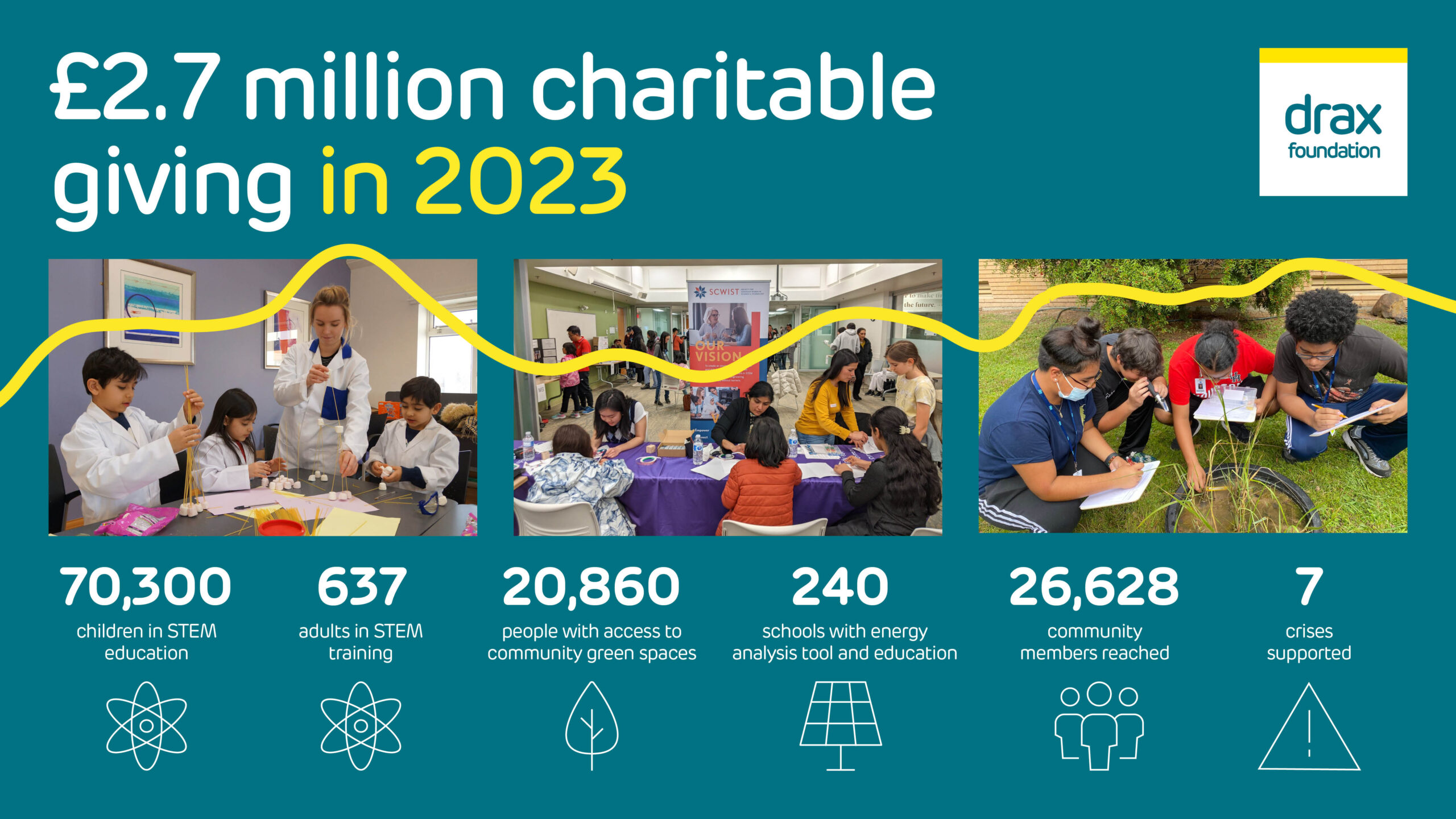
“Drax has a long history of charitable giving and supporting the communities where we operate. We are on track to donate nearly £3m to good causes during 2023.

“Christmas can be a challenging time of year for individuals and families and it is important that companies do what they can to help people. We hope that these donations will provide much needed support to foodbanks across England, Scotland, Canada and the USA to meet the demand for their services.”

England

A combined total of £32,000 has been donated to foodbanks near Drax sites in England including:

  • Bow Food Bank near to Drax’s London head office
  • 2 Rivers Community Pantry and Selby Community Fridge close to Drax Power Station in North Yorkshire
  • The Hope Centre, Kettering District Foodbank and Weston Favel Centre near Opus Energy in Northampton
  • BME Support, St Matthews Church Top Up Shop, Love Ipswich and All Hallows Top Up Shop near to Drax Energy Solutions (DES) in Ipswich

Additionally, nearly 300 festive hampers have been prepared by DES colleagues to be distributed by Love Ipswich to vulnerable people.

Chris Hailey-Norris, Chief Executive of Up for Yorkshire, said:

“Thank you so much for the generous donation from Drax. The funding will enable us to top up the Community Fridge with essential additional food items on a weekly basis.

“The Community Fridge is a lifeline to so many families across Selby District, and a wonderful opportunity to connect people with the other support and services we can provide. Your support means so much to our organisation.”

Scotland

A combined total of £20,000 has been donated to foodbanks near Drax sites in Scotland including:

  • Hope Kitchen Oban near to Cruachan Power Station
  • View Park Food Bank close to Daldowie Fuel Plant
  • Clydesdale Food Bank by Lanark Hydro Scheme
  • Stepping Stones by Galloway Hydro Scheme

Catriona Petit, Service Manager at Hope Kitchen Oban, said:

“It was a welcome surprise to receive this money. People we support are finding it particularly difficult this year with the cost of living crisis and so having money that we can use to provide people with food, activities and places to meet and get involved is invaluable.”

Canada

A combined total of £39,000 or $65,000 (CAD) has been donated to foodbanks near Drax sites in Canada including:

  • Boys and Girls Club Okanagan Armstrong Food Bank by Armstrong Pellet Mill
  • Lake District Family Enhancement Society near to Burns Lake Pellet Mill
  • WEE Community Food Bank close to Entwistle Pellet Mill
  • High Level Native Friendship Centre near High Level Pellet Mill
  • Lumby Food Bank near to Lavington Pellet Mill
  • Nourish Food Bank close to Meadowbank Pellet Mill
  • Salvation Army close to Drax’s Prince George office
  • Princeton Food Bank near to Princeton Pellet Mill
  • Salvation Army Bulkley Valley close to Smithers Pellet Mill
  • Greater Vancouver Food Bank by Drax’s Vancouver office
  • Salvation Army Prince Rupert near to Westview Wood Pellet Terminal
  • Salvation Army Williams Lake close to Williams Lake Pellet Plant

Tamara Robinson, Director of Family Services and Community Outreach at Salvation Army Williams Lake, said:

“On behalf of The Salvation Army Williams Lake I deeply thank Drax for their incredible generosity to our community, supporting us as we serve those in need. It’s because of caring hearts like yours that we are able serve in the capacity we do.”

USA

A combined total of £21,000 or $25,000 (USD) has been donated to foodbanks near Drax sites in the USA including:

  • Louisiana:
    • Food Bank of Northeast LA close to both Drax’s Monroe office and Morehouse Pellet Plant
    • Food Bank of Central LA near to LaSalle Pellet Plant
  • Mississippi:
    • Amite River Baptist Association Food Pantry near to Amite Pellet Plant
  • Alabama:
    • West Alabama Food Bank close to Aliceville Pellet Plant
    • Demopolis Food Pantry near to Demopolis Pellet Plant
  • Arkansas:
    • Mainstreet Mission Food Pantry by Russellville Pellet Plant
    • Kathy’s Closet and Food Pantry near to Leola Pellet Plant

“The Food Bank of Northeast Louisiana is grateful for the opportunity to partner with Drax Biomass to provide more nutritious food to our neighbors who face hunger,” said Food Bank of Northeast Louisiana Executive director Jean Toth. “Thanks to both financial and volunteer support from Drax Biomass, together we are creating a stronger, healthier community.”

ENDS

Media contacts:

Andy Low
Media Manager
E: [email protected]
T: 07841 068 415

About Drax

Drax Group’s purpose is to enable a zero carbon, lower cost energy future and in 2019 announced a world-leading ambition to be carbon negative by 2030, using bioenergy with carbon capture and storage (BECCS) technology.

Drax’s around 3,000 employees operate across three principal areas of activity – electricity generation, electricity sales to business customers and compressed wood pellet production and supply to third parties. For more information visit www.drax.com

Power generation:

Drax owns and operates a portfolio of renewable electricity generation assets in England and Scotland. The assets include the UK’s largest power station, based at Selby, North Yorkshire, which supplies five percent of the country’s electricity needs.

Having converted Drax Power Station to use sustainable biomass instead of coal it has become the UK’s biggest renewable power generator and the largest decarbonisation project in Europe. It is also where Drax is piloting the groundbreaking negative emissions technology BECCS within its CCUS (Carbon Capture Utilisation and Storage) Incubation Area.

Its pumped storage, hydro and energy from waste assets in Scotland include Cruachan Power Station – a flexible pumped storage facility within the hollowed-out mountain Ben Cruachan.

The Group also aims to build on its BECCS innovation at Drax Power Station with a target to deliver 4 million tonnes of negative CO2 emissions each year from new-build BECCS outside of the UK by 2030 and is currently developing models for North American and European markets.

Pellet production and supply:

The Group has 19 operational pellet plants and developments with nameplate production capacity of around 5 million tonnes a year.

Drax is targeting 8 million tonnes of production capacity by 2030, which will require the development of over 3 million tonnes of new biomass pellet production capacity. The pellets are produced using materials sourced from sustainably managed working forests and are supplied to third party customers in Europe and Asia for the generation of renewable power.

Drax’s pellet plants supply biomass used at its own power station in North Yorkshire, England to generate flexible, renewable power for the UK’s homes and businesses, and also to customers in Europe and Asia.

Customers: 

Drax supplies renewable electricity to UK businesses, offering a range of energy-related services including energy optimisation, as well as electric vehicle strategy and management.

To find out more go to the website energy.drax.com

To find out more information about the Drax Foundation go to the website www.drax.com/community

Drax anchors Christmas support for workers at sea

More than £10,000 was raised by Drax and its partners towards this year’s appeal for Mission to Seafarers, a charity which supports people working at sea.

The total raised was more than enough for the target of 600 Christmas parcels, with the additional funds going towards Mi-Fi communications to enable those at sea to stay better connected with their families and friends.

Volunteers from the charity and Drax packed parcels with the donated items and supplies and then distributed to crews on the ships.

Mark Gibbens, Drax Head of Logistics, said: “Our global supply chain operates around the world every single day of the year, even Christmas. The biomass delivered by Sea Farers helps generate renewable power for millions of British homes and businesses.

“We wanted to make sure that at this special time of the year, we took a moment to thank those who are sacrificing time with their families to supply our power station with the renewable fuel that we need. I’d like to thank all our partners who helped on this project. We hope all of those working at sea this Christmas have a safe and pleasant time, despite being away from their families.”

The partners who took part in the initiative alongside Drax were:

  • DAN Shipping
  • Ultrabulk
  • Associated British Ports
  • GB Railfrieght
  • MOL
  • SMS Towage
  • Port of Tyne
  • DB Cargo
  • AHK

Revd. Tim Linkens, Chaplain to The Humber Ports, said: “The work of seafarers is vital to the UK throughout the year. They spend many months away from home working in all weathers.  Much of what they do is unseen and mostly we are unaware of how much they bring to our shores.

“At Christmas time, these gifts reassure seafarers that, although they might be out of sight, they are not out of mind.  They are always received with much joy onboard and all of us involved in seafarer welfare are thankful to those who have donated so generously to make these gifts possible.”

ENDS

Media contacts

Aidan Kerr, Senior Media Manager
E:   [email protected]
T: 07849090368 

About Drax

Drax Group’s purpose is to enable a zero carbon, lower cost energy future and in 2019 announced a world-leading ambition to be carbon negative by 2030, using bioenergy with carbon capture and storage (BECCS) technology.

Drax’s around 3,000 employees operate across three principal areas of activity – electricity generation, electricity sales to business customers and compressed wood pellet production and supply to third parties. For more information visit www.drax.com

Power generation:

Drax owns and operates a portfolio of renewable electricity generation assets in England and Scotland. The assets include the UK’s largest power station, based at Selby, North Yorkshire, which supplies five percent of the country’s electricity needs.

Having converted Drax Power Station to use sustainable biomass instead of coal it has become the UK’s biggest renewable power generator and the largest decarbonisation project in Europe. It is also where Drax is piloting the groundbreaking negative emissions technology BECCS within its CCUS (Carbon Capture Utilisation and Storage) Incubation Area.

Its pumped storage, hydro and energy from waste assets in Scotland include Cruachan Power Station – a flexible pumped storage facility within the hollowed-out mountain Ben Cruachan.

The Group also aims to build on its BECCS innovation at Drax Power Station with a target to deliver 4 million tonnes of negative CO2 emissions each year from new-build BECCS outside of the UK by 2030 and is currently developing models for North American and European markets.

Pellet production and supply:

The Group has 19 operational pellet plants and developments with nameplate production capacity of around 5 million tonnes a year.

Drax is targeting 8 million tonnes of production capacity by 2030, which will require the development of over 3 million tonnes of new biomass pellet production capacity. The pellets are produced using materials sourced from sustainably managed working forests and are supplied to third party customers in Europe and Asia for the generation of renewable power.

Drax’s pellet plants supply biomass used at its own power station in North Yorkshire, England to generate flexible, renewable power for the UK’s homes and businesses, and also to customers in Europe and Asia.

Customers: 

Drax supplies renewable electricity to UK businesses, offering a range of energy-related services including energy optimisation, as well as electric vehicle strategy and management.

To find out more go to the website www.energy.drax.com
Drax donates £50,000 to Movember to support men’s health

The donation follows over 700 Drax employees expressing their support for Movember throughout the last month, by either growing moustaches or taking photos of themselves with a fake moustache prop.

The donation will help Movember continue to campaign to raise awareness of men’s mental health, rates of male suicide and of the threat of prostate and testicular cancer.

Each year Movember sees people across the globe encouraged to ‘grow a mo’ to show support for the charity’s goals, men’s health and a healthier world.

Drax Power Station in North Yorkshire had the highest number of employees across Drax Group participating in Movember activities, with over 400 colleagues, including apprentices, engineers, the senior leadership team and more, expressing their support by sharing photos and stories.

Bruce Heppenstall, Plant Director, Drax Power Station said:

“Movember is driving much needed change and opening up vital conversations around men’s health. I was proud to see so many colleagues across Drax Power Station and the wider business getting involved in supporting the organisation and hope that we can get even more colleagues involved next year.

“Drax is committed to giving back to the communities where we operate through a number of initiatives including the company’s charitable entity Drax Foundation. This donation will help Movember to continue doing its critical work.”

Movember has been actively campaigning for 20 years and has funded over 1,300 men’s health projects around the world. It continues to conduct men’s health research and transform the way health services reach and support men.

Media contacts:

Andy Low
Media Manager
E: [email protected]
T: 07841 068 415

About Drax

Drax Group’s purpose is to enable a zero carbon, lower cost energy future and in 2019 announced a world-leading ambition to be carbon negative by 2030, using bioenergy with carbon capture and storage (BECCS) technology.

Drax’s around 3,000 employees operate across three principal areas of activity – electricity generation, electricity sales to business customers and compressed wood pellet production and supply to third parties. For more information visit www.drax.com

Power generation:

Drax owns and operates a portfolio of renewable electricity generation assets in England and Scotland. The assets include the UK’s largest power station, based at Selby, North Yorkshire, which supplies five percent of the country’s electricity needs.

Having converted Drax Power Station to use sustainable biomass instead of coal it has become the UK’s biggest renewable power generator and the largest decarbonisation project in Europe. It is also where Drax is piloting the groundbreaking negative emissions technology BECCS within its CCUS (Carbon Capture Utilisation and Storage) Incubation Area.

Its pumped storage, hydro and energy from waste assets in Scotland include Cruachan Power Station – a flexible pumped storage facility within the hollowed-out mountain Ben Cruachan.

The Group also aims to build on its BECCS innovation at Drax Power Station with a target to deliver 4 million tonnes of negative CO2 emissions each year from new-build BECCS outside of the UK by 2030 and is currently developing models for North American and European markets.

Pellet production and supply:

The Group has 19 operational pellet plants and developments with nameplate production capacity of around 5 million tonnes a year.

Drax is targeting 8 million tonnes of production capacity by 2030, which will require the development of over 3 million tonnes of new biomass pellet production capacity. The pellets are produced using materials sourced from sustainably managed working forests and are supplied to third party customers in Europe and Asia for the generation of renewable power.

Drax’s pellet plants supply biomass used at its own power station in North Yorkshire, England to generate flexible, renewable power for the UK’s homes and businesses, and also to customers in Europe and Asia.

Customers: 

Drax supplies renewable electricity to UK businesses, offering a range of energy-related services including energy optimisation, as well as electric vehicle strategy and management.

To find out more go to the website energy.drax.com

To find out more information about the Drax Foundation go to the website www.drax.com/community

Young apprentice stars shine at Drax awards

The ceremony, held near Selby in North Yorkshire, brought together apprentices from across the company’s UK operations to celebrate the outstanding contribution they have made to Drax.

The big winner of the night was Josh Smith, 28, from Oban, for his work at Drax’s iconic ‘Hollow Mountain’ Cruachan Power Station. Not only did he bag the Apprentice of the Year (Year 4 Craft) award, but he also walked away with the ‘Paul Chambers Outstanding Achievement Award 2023,’ the biggest prize on offer at the event.

The awarding judges commended Josh for his role in delivering several complex projects at Cruachan. During the year he even earned an additional Higher National Certificate (HNC) on top of his normal studies.

On receiving his awards, Josh said: “I’m grateful to everyone at Cruachan for the incredible opportunity and the invaluable lessons I’ve learned. The support and mentorship have been instrumental in my professional growth.

“The knowledge and skills acquired here have prepared me well for future challenges. I look forward to applying what I’ve learned and continuing to progress in my career.”

Other young apprentices from across Drax were also recognised at the event. Human Resources apprentice Erin Rodger, 17, from Thorpe Willoughby, a village close to Drax Power Station, was awarded Business Apprentice of the Year (Level 2-4). She was praised for her can do attitude, for the positive example she consistently sets for her colleagues, and for her confidence, commitment, and ability to any task she’s given.

Erin said: “I’m really proud of myself for winning this award. It feels amazing to have been recognised for my work and growth over the last year. I have learnt so much already at Drax and I’m looking forward to my second year.”

One of the hosts for the evening was Ian Kinnaird, Drax’s Scottish Assets Director, who praised the work of all those involved.

Speaking after the ceremony, he said: “It is fantastic to be able to give young people the first step in their careers through our apprenticeship programme here at Drax. Our apprentices have unique talents and bring new perspectives that we can all learn from.

“All of the award winners and nominees should all be extremely proud of themselves, and we look forward to seeing how their careers progress here at Drax.”

This year’s winners were:

  • The Paul Chambers Overall Outstanding Achievement – Josh Smith, age 28 from Oban and based at Cruachan Power Station.
  • Business Apprentice of the year, Cyber Security (Year 3, Level 5-7) – Shane Panizales, age 26 and based at Drax Power Station.
  • Business Apprentice of the year, Human Resources (Year 2, Level 2-4) – Erin Rodger, age 17, from Thorpe Willoughby near Selby, and based at Drax Power Station.
  • Craft Apprentice of the year (Scotland, Year 4) – Josh Smith, age 28 from Oban.
  • Craft Apprentice of the year (Scotland, Year 3) – Paul Firth, age 21 from Motherwell.
  • Craft Apprentice of the year (Scotland, Year 1) – Lewis Bennett, age 22 from East Kilbride.
  • Technical Apprentice of the year (Year 1) – Jack Woods, age 21 from Willoughby.
  • Technical Apprentice of the year (Year 2) – Sam Easthill, age 23 from Cliffe.
  • Technical Apprentice of the year (Year 3) – Declan Farmer, age 20 from Gilberdyke.
  • Technical Apprentice of the year (Year 4) – Simran Ley, age 24 from Swinefleet

The craft and technical apprenticeship initiative, spanning four years, offers new recruits an opportunity to work alongside highly qualified engineers, gaining skills in three key engineering disciplines: Mechanical, Electrical, and Control & Instrumentation. Drax also offers apprenticeship opportunities to areas in business support such as HR, cybersecurity, IT, facilities, and network security.

As Drax progresses plans to expand its new pumped storage hydro site at Cruachan in Scotland, as well as deploying bioenergy with carbon capture (BECCS) at the power station in Selby, the opportunities for apprentices within the renewable power industry have never been greater.

ENDS

Aidan Kerr
Senior Media Manager
E: [email protected]
T: 07849090368

Editor’s Notes

Drax has been running an apprenticeship scheme for almost two decades at its eponymous power station in North Yorkshire and also offers internships and graduate schemes as part of its dedication to improving skills and increasing opportunities for young people across the region.

Drax runs a variety of initiatives to support STEM education and skills including offering power station tours, interactive workshops and work experience opportunities.

Applications will be opening soon for Drax’s next work experience for students in Y10-Y12 or S4-S6 in Scotland. For more details go to www.drax.com/careers.

About Drax

Drax Group’s purpose is to enable a zero carbon, lower cost energy future and in 2019 announced a world-leading ambition to be carbon negative by 2030, using bioenergy with carbon capture and storage (BECCS) technology.

Drax’s around 3,000 employees operate across three principal areas of activity – electricity generation, electricity sales to business customers and compressed wood pellet production and supply to third parties. For more information visit www.drax.com

Power generation:

Drax owns and operates a portfolio of renewable electricity generation assets in England and Scotland. The assets include the UK’s largest power station, based at Selby, North Yorkshire, which supplies five percent of the country’s electricity needs.

Having converted Drax Power Station to use sustainable biomass instead of coal it has become the UK’s biggest renewable power generator and the largest decarbonisation project in Europe. It is also where Drax is piloting the groundbreaking negative emissions technology BECCS within its CCUS (Carbon Capture Utilisation and Storage) Incubation Area.

Its pumped storage, hydro and energy from waste assets in Scotland include Cruachan Power Station – a flexible pumped storage facility within the hollowed-out mountain Ben Cruachan.

The Group also aims to build on its BECCS innovation at Drax Power Station with a target to deliver 4 million tonnes of negative CO2 emissions each year from new-build BECCS outside of the UK by 2030 and is currently developing models for North American and European markets.

Pellet production and supply:

The Group has 17 operational pellet plants and developments with nameplate production capacity of around 5 million tonnes a year.

Drax is targeting 8 million tonnes of production capacity by 2030, which will require the development of over 3 million tonnes of new biomass pellet production capacity. The pellets are produced using materials sourced from sustainably managed working forests and are supplied to third party customers in Europe and Asia for the generation of renewable power.

Drax’s pellet plants supply biomass used at its own power station in North Yorkshire, England to generate flexible, renewable power for the UK’s homes and businesses, and also to customers in Europe and Asia.

Customers:  

Drax supplies renewable electricity to UK businesses, offering a range of energy-related services including energy optimisation, as well as electric vehicle strategy and management.

To find out more go to the website www.energy.drax.com

Green power surge: Britain’s cleanest power grid ever

Renewables supplied more than 40% of Britain’s electricity demand, their highest share for the third quarter of the year on record.  This made it the lowest carbon quarter on record, with emissions falling below 150 g/kWh for the first time ever.

Last quarter’s generation mix produced an average of just 143 grams of CO2 per kWh.  This is the first time that the milestone of 150 g/kWh has been beaten over a quarter and comes more than three years since this record was last broken, during the COVID lockdowns of early 2020.

The findings are published during the COP28 climate conference in the United Arab Emirates and are part of the latest instalment of the quarterly Drax Electric Insights report. The publication is an independent report by academics from Imperial College London commissioned through Imperial Consultants.

Quarterly average carbon intensity of electricity generation over the last decade, log scale

Dr Iain Staffell of Imperial College London, and lead author of the quarterly Drax Electric Insights report series, said:

“This is a milestone moment in the UK’s decarbonisation journey, getting our carbon emissions down by more than two-thirds in just a decade is a real achievement.

“With our renewable capacity continuing to grow, we should see more clean power records broken in the coming years. However, the long-term picture is more complicated, and it is vital that government continues to explore how to unlock investment in clean energy technologies.

“The rise in electric vehicles and heat pumps will push up electricity demand. We need to build more renewables of all types and kick-start negative emissions technologies, to not just keep pace with demand growth, but continue growing the share of clean energy and keep carbon emissions falling.”

One of the most striking illustrations of Britain’s changing power grid is the decline of coal. New analysis by Drax Electric Insights has found in the 12 months to October 2023, coal supplied less than 1% of Britain’s electricity for the first time ever. The country’s last remaining coal-fired power station will be retired next year as part of the Government’s commitment to end the use of the fuel in electricity production by October 2024.

The 12-month rolling average share of electricity demand met by coal in Britain and the world’s largest countries by GDP. International data from Ember

Britain’s move away from coal took shape over the last decade. A combination of air quality regulations, increasing carbon prices, and converting coal plants to run on biomass meant that Britain’s coal output fell by over 40% per year in the five years to 2020. In contrast, the share of electricity from coal has remained almost static in China, India, and Japan since 2015.

Around the world, 48 countries have committed to stop using coal for electricity over the coming decades.  Efforts to expand the “phase-down” of coal failed at COP26 and 27, meaning extending this to become a global commitment remains a centre-stage issue at COP28 in the United Arab Emirates.

Penny Small, Drax’s Interim Chief Operations Officer, said:

“Getting coal off the grid and replacing it with renewables such as biomass has been transformational for the UK.

“By converting Drax Power Station to use biomass we have secured jobs and simultaneously strengthened the UK’s energy security through generating a reliable source of dispatchable, renewable electricity for millions of homes and businesses.

“We’re now planning to go further by using bioenergy with carbon capture and storage (BECCS) to permanently remove millions of tonnes of carbon dioxide from the atmosphere each year, and we are engaged in discussions with the UK Government to move this project forward.

“The global momentum for converting coal-fired power stations to biomass is growing as more countries work to reduce their emissions by moving away from fossil fuels to renewables while maintaining their energy security. If BECCS were eventually added to each of these sites, they would be able to remove carbon from the atmosphere while generating renewable power.”


ENDS


Media contacts:

Aidan Kerr, Senior Media Manager
E:   [email protected]
T:   07849090368

About Drax

Drax Group’s purpose is to enable a zero carbon, lower cost energy future and in 2019 announced a world-leading ambition to be carbon negative by 2030, using bioenergy with carbon capture and storage (BECCS) technology.

Drax’s around 3,000 employees operate across three principal areas of activity – electricity generation, electricity sales to business customers and compressed wood pellet production and supply to third parties. For more information visit www.drax.com

Power generation:

Drax owns and operates a portfolio of renewable electricity generation assets in England and Scotland. The assets include the UK’s largest power station, based at Selby, North Yorkshire, which supplies five percent of the country’s electricity needs.

Having converted Drax Power Station to use sustainable biomass instead of coal it has become the UK’s biggest renewable power generator and the largest decarbonisation project in Europe. It is also where Drax is piloting the groundbreaking negative emissions technology BECCS within its CCUS (Carbon Capture Utilisation and Storage) Incubation Area.

Its pumped storage, hydro and energy from waste assets in Scotland include Cruachan Power Station – a flexible pumped storage facility within the hollowed-out mountain Ben Cruachan.

The Group also aims to build on its BECCS innovation at Drax Power Station with a target to deliver 4 million tonnes of negative CO2 emissions each year from new-build BECCS outside of the UK by 2030 and is currently developing models for North American and European markets.

Pellet production and supply:

The Group has 19 operational pellet plants and developments with nameplate production capacity of around 5 million tonnes a year.

Drax is targeting 8 million tonnes of production capacity by 2030, which will require the development of over 3 million tonnes of new biomass pellet production capacity. The pellets are produced using materials sourced from sustainably managed working forests and are supplied to third party customers in Europe and Asia for the generation of renewable power.

Drax’s pellet plants supply biomass used at its own power station in North Yorkshire, England to generate flexible, renewable power for the UK’s homes and businesses, and also to customers in Europe and Asia.

Customers: 

Drax supplies renewable electricity to UK businesses, offering a range of energy-related services including energy optimisation, as well as electric vehicle strategy and management.

To find out more go to the website www.energy.drax.com

 

View the full report here


Drax Foundation donates nearly £1m to support STEM education and community initiatives in the UK and North America

  • New funding will go to projects where Drax Group operates in the UK, USA and Canada and takes Drax’s donations in 2023 to over £4.6m.  
  • This latest donation of nearly £1m will enable over 32,000 young people to access STEM training, 1,229 ha of land to be restored and over 20,000 people to get better access to green spaces.  

The Drax Foundation, the charitable entity of renewable energy company Drax Group (Drax), has donated £862,000 to 19 non-profit organisations across the regions where it operates in the UK and North America 

This new funding means that in 2023 the total Drax has committed to philanthropic funding is over £4.6million. 

Shona King, Drax Head of Community, said: “In its first year, The Drax Foundation has established a proud track record of giving back to the communities where we operate. We are guided by the needs of our non-profit partners, which is why we are pleased to fund some of their challenging areas of work.”

The Drax Foundation is focused on funding initiatives that support education and skills development in Science Technology Engineering and Maths (STEM), those that improve green spaces and enhance biodiversity within local communities and improve access to renewable energy and energy efficiency in areas of low social mobility. 

The projects funded in this round will mean over 32,000 young people can benefit from STEM training, 1,229 hectares of land will be restored or protected and over 20,000 people will receive improved access to green spaces in their communities. 

Shona continued: “2023 has seen an exciting new chapter in how Drax delivers positive social impact and made a tangible difference to people’s lives. We are excited about the opportunity to build on this over the coming years to ensure that more young people can develop their STEM skills, have access to quality local green spaces, and be lifted out of fuel poverty through access to affordable renewable energy, and energy efficiency measures”.

The new funding has been awarded across the UK, US and Canada and is the second round of grants the Foundation has issued since it was launched in March 2023. 

Of the total, over £300,000 has been donated to eight projects in the UK, where Drax operates Drax Power Station and has other operations in Northampton, Suffolk and Scotland. These include:  

  • Teach First: A charity with a mission to end educational inequality in the UK. Drax’s donation will help recruit 37 STEM trainee teachers, providing consistent teaching to 4,625 pupils. 
  • Enthuse STEM Learning: A UK not-for-profit with a vision for world-leading STEM education for every young person. Drax’s donation will facilitate partnerships in disadvantaged communities, providing STEM education for 12,800 young people. 

Over US $348,000 has been awarded to six different projects in North America where Drax owns several pellet plants and has recently opened its BECCS headquarters. These include: 

Drax Foundation funding is available for organisations ranging from smaller community-led projects to larger grants of up to £100,000 for established non-profit organisations. 

Priority is given to organisations that deliver programmes for under-served and under-represented groups, advance gender equality and support indigenous communities. 

Organisations and initiatives that meet Drax’s funding and selection criteria are encouraged to visit www.drax.com/community to learn more about the Foundation and submit an initial expression of interest. The Foundation is already accepting applications for 2024’s first round of funding.   

The Drax Foundation is a donor advised fund administered by the Charities Trust (an independently registered charity with the UK Charity Commission, charity no. 327489  

ENDS 

Media contacts: 

Nicolas Morales
Communications Officer
E: [email protected]
T: 07756 289 343

Notes to Editors

If you would like a quote or comment from one of the successful recipients of this round of funding, please contact Nicolas. 

About Drax  

Drax Group’s purpose is to enable a zero carbon, lower cost energy future and in 2019 announced a world-leading ambition to be carbon negative by 2030, using bioenergy with carbon capture and storage (BECCS) technology.  

Drax’s around 3,000 employees operate across three principal areas of activity – electricity generation, electricity sales to business customers and compressed wood pellet production and supply to third parties. For more information visit www.drax.com 

Power generation:  

Drax owns and operates a portfolio of renewable electricity generation assets in England and Scotland. The assets include the UK’s largest power station, based at Selby, North Yorkshire, which supplies five percent of the country’s electricity needs.   

Having converted Drax Power Station to use sustainable biomass instead of coal it has become the UK’s biggest renewable power generator and the largest decarbonisation project in Europe. It is also where Drax is piloting the groundbreaking negative emissions technology BECCS within its CCUS (Carbon Capture Utilisation and Storage) Incubation Area.  

Its pumped storage, hydro and energy from waste assets in Scotland include Cruachan Power Station – a flexible pumped storage facility within the hollowed-out mountain Ben Cruachan.   

The Group also aims to build on its BECCS innovation at Drax Power Station with a target to deliver 4 million tonnes of negative CO2 emissions each year from new-build BECCS outside of the UK by 2030 and is currently developing models for North American and European markets. 

Pellet production and supply:

The Group has 19 operational pellet plants and developments with nameplate production capacity of around 5 million tonnes a year. 

Drax is targeting 8 million tonnes of production capacity by 2030, which will require the development of over 3 million tonnes of new biomass pellet production capacity. The pellets are produced using materials sourced from sustainably managed working forests and are supplied to third party customers in Europe and Asia for the generation of renewable power.  

Drax’s pellet plants supply biomass used at its own power station in North Yorkshire, England to generate flexible, renewable power for the UK’s homes and businesses, and also to customers in Europe and Asia. 

Customers:    

Drax supplies renewable electricity to UK businesses, offering a range of energy-related services including energy optimisation, as well as electric vehicle strategy and management.  

To find out more go to the website energy.drax.com