






Our Approach
We recognise the interaction and dependency we have with nature. From the sustainable biomass we source, to the water needed to operate Drax Power Station and to generate electricity at our Scottish assets, nature is fundamental to our business. We are committed to understanding and addressing nature-related risks, our dependencies and impacts on nature, and contributing to actions that promote nature positive outcomes.
Objective
At Drax, “nature positive“ means going beyond avoiding or minimising our impacts on nature and contributing to ways to restore and enhance nature.
Our Sustainability Framework outlines the three key areas where we will be taking action for nature:

- We will mitigate harm and promote circular resource use across our operations by 2030.
- We will deliver biodiversity enhancements across all our sites by 2030.
- We will support ecosystem biodiversity and resilience, contributing to measurable restoration and conservation outcomes by 2030.
This will be measurable and evidenced, backed by a science-based target for nature and action plans across our sites and sourcing areas.
Our approach for Nature Positive
The loss of nature and biodiversity poses significant risk to the stability of economies, the wellbeing of society, and the globe more generally. PwC research from 2023 found that up to 55% of the world’s GDP is exposed to material nature risk.
From the sustainable biomass that Drax produces in the US and Canada, to the water used for cooling at Drax Power Station as well as powering our hydroelectric and pumped-storage facilities in Scotland, Drax interacts with, and depends on, nature. We are committed to understanding and addressing our dependencies and impacts on nature, our nature-related risks, and contributing to actions that promote nature positive outcomes. We are committed to identifying and seizing opportunities to reduce these impacts.
Governance for nature
The Chief Sustainability Officer is responsible for the implementation of the Group’s sustainable development framework, including nature positive commitments.
The Executive Committee and the Board received updates on nature in 2024, through the respective reporting mechanisms.
Our Independent Advisory Board provides external advice on the science and evidence underpinning practices to protect nature and support nature recovery.
The Nature Expert Hub serves as the co-ordination point for nature positive actions across Drax and oversight of nature-related projects across the business.
Environmental management and compliance
Our Group Environmental Policy states our commitment to manage, monitor, and reduce the environmental impacts caused by our business. We report monthly on environmental incidents to the Executive Committee, and the Compliance Committee Steering Committee also receives a report.
Non-CO2 emissions to air
For biomass generation, the main emissions to air are nitrogen oxides, sulphur dioxide, particulates, and VOCs. These are caused by the machinery and processes associated with harvesting and pelletisation of biomass. In 2025, sulphur dioxide and nitrogen oxides emissions reduced compared with 2024.
Pellet production operations are subject to local State laws for air emissions and pollutants and set requirements on the level and frequency of self-monitoring and reporting. The main emissions to air are particulates, volatile organic compounds (VOCs), carbon monoxide, and nitrogen oxides.
Responding to local concerns
In October 2025, the Amite facility in Gloster, Mississippi received unanimous approval from Mississippi Department of Environmental Quality for both a modified construction permit and an initial Title V operating permit. This reversed an earlier decision from April 2025. The approval followed a two-day public hearing that drew strong participation from the Gloster community, many of whom expressed support for Drax continuing operations, alongside perspectives aligned with Greater Green Gloster. Although the final administrative steps are still underway, we anticipate that the permits will be formally issued in the first half of 2026. Once in place, they will provide enhanced operational transparency and reinforce confidence in our environmental performance. We remain committed to being a responsible and engaged partner in Gloster and will continue to strengthen our relationships in the community. We engage with regulators and other stakeholders in connection with our operations through established regulatory and administrative processes. Our operations are subject to permits, oversight, and ongoing regulatory and legal requirements. Certain regulatory, administrative, or legal matters may be ongoing from time to time.
Water
The use of water is subject to strict criteria and local laws, with our operational and HSE teams, plus external regulatory agencies, overseeing compliance. Drax Power Station uses water for operational and cooling processes. The power station emits a proportion of the water it uses as water vapour through its cooling towers. It recycles the remainder and discharges it under permit to the River Ouse. We have procedures in place to manage water system efficiency and usage, ensuring the plant meets the discharge consent limits.
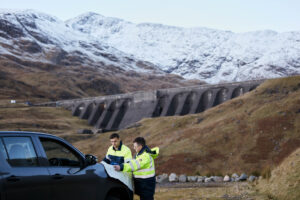
At Cruachan Power Station, we generate electricity by using water that flows from Cruachan dam through four turbines into Loch Awe. Cruachan can reach its full generating capacity in less than 30 seconds, which makes it a vital asset for balancing the grid and generating electricity at times of high demand. When electricity demand is low, we pump water from Loch Awe into the upper reservoir. We monitor the arrangements for the cycling of this water and report to the Scottish Environment Protection Agency (SEPA) as required.
As part of our Sustainability Framework, we have committed to delivering a Group water strategy by the end of 2026, which will take into account our existing asset base as well as potential future opportunities, including data centres.
Framework in focus
The areas that we operate in are home to rich and unique biodiversity. The land around our sites supports hundreds of species, and the forests we source biomass from are similarly full of life. Avoiding and preventing negative impacts on nature is critically important and remains a key area of focus for us.
But we know we’re still at the beginning of the journey. We’re committed to taking action that not only aims to protect nature across all our sites, but actively enhance it. We’ll aim to do this through the 10 targets outlined in the Nature Positive section of our Sustainability Framework, three of which we have considered in more detail here.
Target
Publish a white paper on opportunities to adopt circular economy principles with a focus on circular bioeconomy by the end of 2025
Progress
In 2025, we initiated new multi-stakeholder discussions on the circular bioeconomy as part of our commitment to explore further adoption of circular economy principles. We commissioned Forum for the Future, a leading international sustainability organisation dedicated to a just and regenerative future, to lead this work. Forum for the Future facilitated a workshop with stakeholders from across the bioeconomy value chain, and will publish a white paper in early 2026. We will feature this in the Drax Evidence Hub along with our key takeaways.
In 2025, we continued to develop Nature Positive Action Plans using information developed in our TNFD ‘Locate, Evaluate, Assess & Prepare’ (LEAP) assessments based on the TNFD definition of Nature Action Plan. We developed a first plan for Drax Power Station and for Cruachan, identifying priority nature-related dependencies, impacts, risks and opportunities, and informing where to focus our nature positive actions.
We continued to progress LEAP assessments across the Drax portfolio and sourcing areas. We leveraged data from the Integrated Biodiversity Assessment Tool (IBAT), a leading global biodiversity data set, and local biodiversity surveys. This helps us to better understand areas of biodiversity sensitivity in our operating and biomass sourcing areas, and also informs the Nature Positive Action Plans.


Page updated April 2026