





We are committed to responsible biomass sourcing, outlined in our biomass principles, which can generate broader benefits and create positive outcomes across the value chain.
Utilising low-grade woody fibre from forests helps prevent the spread of fire, pests, and disease by reducing forest density to healthier levels. We believe it is far better to utilise this fibre according to strict criteria and best practice, in order to generate social value and renewable electricity.
Traceability and Transparency
The Drax Biomass Tracker is a digital tool showing the journey our woody biomass takes through the supply chain, from fibre origin to its final use at Drax Power Station or by third-party customers.
Reducing carbon dioxide emissions
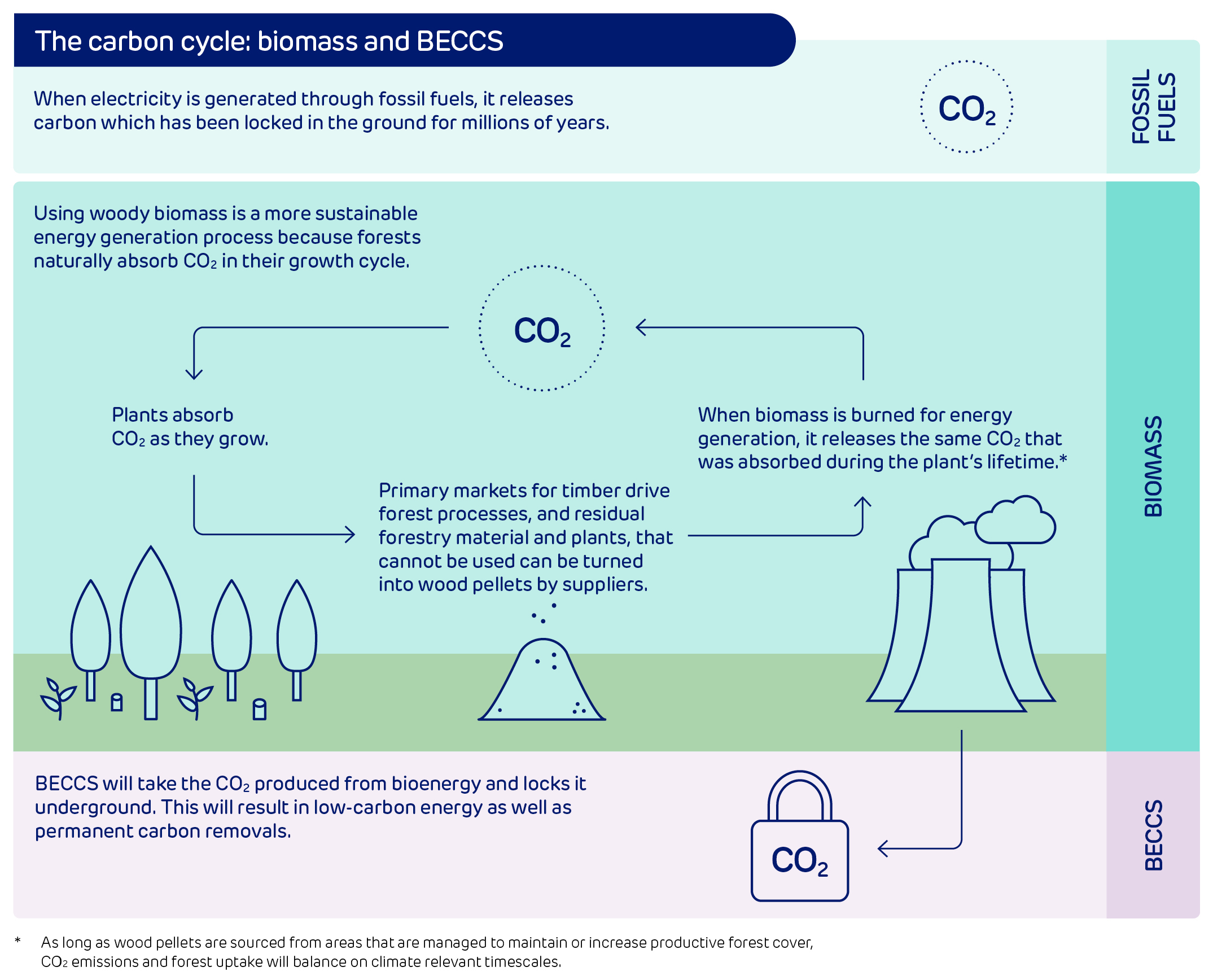
We are committed to ensuring our use of biomass makes a positive contribution to tackling climate change which we believe can contribute to fulfilling the UK’s net zero target by 2050.
Protecting the natural environment
We recognise our part in supporting a thriving forestry industry and to respect the many benefits that forests bring, including carbon storage, protection of soil and water quality, supporting biodiversity and provision of habitat.
Supporting people and communities
From state-owned forests to smallholdings, and from British Columbia to the Baltic states, forest owners, forest workers, and communities in our sourcing areas are bound by their common reliance on forests for employment, wellbeing, and quality of life.
Investing in research, outreach, and intervention
The strength of our collaboration with others will improve the sourcing choices we make. We are committed to working with governments, non-governmental organisations, academia, and other stakeholders to continually improve biomass sourcing and develop best practice that reflects our goals for Climate, Nature and People positive outcomes.
Ethics and Human rights
We have introduced our Ethical due diligence programme and this underpins several of our Business Ethics programmes by helping to identify initial and ongoing risks associated with a proposed commercial relationship. In 2024, a project commenced to strengthen our supplier data and supplier on-boarding process and systems beyond biomass.
Activity relating to the Supply Chain Human Rights programme is set out in our latest Modern Slavery Statement.
Drax Group sources of fibre
53%
Sawmill and other wood industry residues
29%
Low-grade roundwood
11.5%
Thinnings
| Sawmill and other wood industry residues (t) | Branches and tops (t) | Thinnings (t) | Low-grade roundwood (t) | Salvage trees* (t) | Non-woody biomass** (t) | Country total (t) | |
|---|---|---|---|---|---|---|---|
| US | 2,672,716 | 116,112 | 1,096,284 | 1,819,805 | 10,586 | 161,562 | 5,877,065 |
| Canada | 2,404,616 | 212,023 | – | 207,181 | 9,777 | – | 2,833,597 |
| Latvia | 111,997 | 16,212 | 9 | 734,816 | – | – | 863,034 |
| Estonia | – | 320 | 10,155 | 48,621 | – | – | 59,096 |
| United Kingdom | – | – | – | – | – | 48,847 | 48,847 |
| Portugal | 735 | 24 | 21,082 | 9,128 | 213 | – | 31,182 |
| Lithuania | 9,395 | – | – | 7,997 | – | – | 17,392 |
| Brazil | 360 | – | – | – | 4,967 | – | 23,394 |
| Other European | 2,122 | – | – | 750 | – | – | 14,184 |
| Total | 5,201,941 | 344,691 | 1,127,530 | 2,828,298 | 25,543 | 210,409 | 9,738,412 |
* In 2025, SBP published standards v.2.0 within which SBP differentiated Salvage Trees and End-of-life Trees. Prior to this standard change both categories were combined and referred to as End-of-life Trees. For Annual Reporting in 2025, Drax has reflected this change. Biomass consumed by DPS covering this Annual report only contains Salvage Trees.
** Following a review of terminology, the category previously titled Agricultural Residues has been renamed in the 2025 Annual report to Non-woody biomass in order to more closely reflect RO Sustainability Criteria.
Types of feedstock (global)
- Sawmill and other wood industry residues
- Low-grade roundwood
- Thinnings
- Agricultural residues
- Branches and tops
- End-of-life trees
Woody material produced during the processing of wood at the sawmill, such as sawdust, shavings, chips, and offcuts.
Low-grade roundwood is material which does not satisfy the quality standards set by the timber industry and is unsuitable for use in a sawmill.
Wood from a silvicultural operation where the main objective is to reduce the density of trees in a stand, improve the quality and growth of the remaining trees and produce a saleable product.
Non-woody processing residues, that are not the end product that a production process directly seeks to produce.
Tops, bark and limbs of trees that have been left behind post harvest.
Trees that are felled because they have defective stems, are ill or damaged or trees that are removed from a plantation because they have reached the end of their productive lifetime or trees that must be removed for the permitted construction of infrastructures.
Woody material produced during the processing of wood at the sawmill, such as sawdust, shavings, chips, and offcuts.
View MoreLow-grade roundwood is material which does not satisfy the quality standards set by the timber industry and is unsuitable for use in a sawmill.
View MoreWood from a silvicultural operation where the main objective is to reduce the density of trees in a stand, improve the quality and growth of the remaining trees and produce a saleable product.
View MoreNon-woody processing residues, that are not the end product that a production process directly seeks to produce.
View MoreTops, bark and limbs of trees that have been left behind post harvest.
View MoreTrees that are felled because they have defective stems, are ill or damaged or trees that are removed from a plantation because they have reached the end of their productive lifetime or trees that must be removed for the permitted construction of infrastructures.
View MoreThe Sustainable Biomass Program (SBP) certification system
SBP is a certification system designed for woody biomass used in industrial energy production. Originally created by biomass generators, SBP has evolved and has had a multi-stakeholder governance structure since 2019.
When we receive woody biomass at Drax Power Station, the majority is delivered with a “claim” to evidence SBP compliance. In 2025, 99.9% of material consumed at Drax Power Station was SBP Compliant.
SBP’s Standard outlines the sustainability requirements which must be assessed by a third-party auditor to achieve SBP Compliant status. The new SBP Standard, published in May 2023, was subject to multi-stakeholder review. The SBP feedstock standards cover a wide range of sustainability issues, including legal sourcing, carbon stock management, environmental impacts (including biodiversity and ecosystems) and impacts on people and communities.