




Our Approach
Responding to the challenge of climate change is central to our purpose and strategic aims. Our Climate Policy outlines our approach in line with the TCFD framework.
Objective
Reaching net zero by the end of 2040 across our value chain.
Our objective isn’t just to reduce emissions, but to have a net positive impact on the climate.

Our Group Climate Policy is reviewed and re-approved annually by our Executive Committee and outlines our approach in line with the Taskforce on Climate-related Financial Disclosures (TCFD) framework.
Ambition and targets
Our climate ambition is to achieve our 2030 and 2040 SBTi decarbonisation goals. Simultaneously, we will deliver our corporate strategic objectives, contributing to UK energy security. While we pursue options for carbon removals, we are also focused on finding opportunities to reduce our absolute emissions across Scopes 1, 2 and 3. The SBTi validated our near-term targets in 2023 and in early 2026, we completed the final steps to fully validate our 2040 net zero target.
We recognise that there are many external dependencies that could impact our target to be net zero by 2040. These include the rate of commercialisation and deployment of low-carbon technologies, and changes to the Group’s corporate strategic objectives and asset portfolio composition.
Understanding our carbon emissions
Carbon and energy use data summary
Scope 1 and 2 emissions
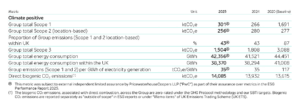
In 2025, our total Scope 1 and 2 carbon emissions (location-based) increased by 2% from 2024, however, we have generated more electricity and produced more pellets in this period. There has been a reduction in non-biogenic energy consumption per pellet produced at the North American pellet plants resulting from the success of energy efficiency projects in 2024. These projects have contributed to an 3% reduction in natural gas emissions, and, alongside decarbonisation of the regional grids, a 5% reduction in location-based electricity emissions.
A continued focus on energy efficiency measures at Drax Power Station also decreased Scope 1 and 2 emissions from the site by 1% in 2025. We have signed off funding for decarbonisation measures on our time charter vessels, to be implemented in 2026, targeting further Scope 1 and 2 emissions reductions, and ensuring a focus on achieving our 2030 non-generation target.
Scope 3 (value chain) emissions
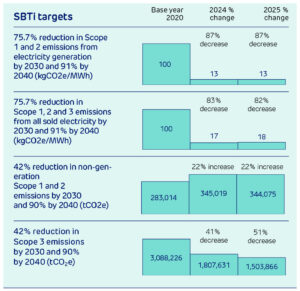
The most significant contributor to our Scope 3 emissions profile continues to be from fuel and energy-related activities, primarily driven by the biomass fuel supply chain. In 2025, Group total Scope 3 emissions decreased by 11% compared with 2024. Efficiencies within the biomass supply chain have supported decarbonisation within our Scope 3 emissions, including our project to replace diesel with 100% hydrotreated vegetable oil (HVO) in our UK rail operations. We have progressed beyond our 2030 target, with a 51% reduction against our 2020 baseline.

In our ESG Performance Report, we provide additional carbon data, including carbon emissions by greenhouse gas type and scope 3 emissions by category.
Carbon reduction targets
Carbon reduction targets are an integral part of key performance indicators (KPIs) in our business. For the 2026 Group Scorecard, a 5% weighting was allocated to achievement of carbon reduction KPIs: a modelled 2.5% reduction in carbon emissions for the Group, across greenhouse gas scope 1, 2 and 3.
Progress against SBTi targets
In summary, we remain ahead of our Generation Scope 1 and 2 intensity target, and progressed beyond our Scope 3 target. Our Scope 1 and 2 non-generation targets remain behind target trajectory, and will require additional decarbonisation focus in 2026.
We completed a re-baseline in 2025 to account for the Opus energy accounts sale, and a number of methodology improvements. For the methodological changes, we have updated emissions factors for spend-based calculations from a dataset developed in 2019, to a 2025 dataset. This update impacted absolute emissions and has been performed across all annual figures, ensuring consistency and preventing faux decarbonisation reporting.
Our carbon reduction pathway
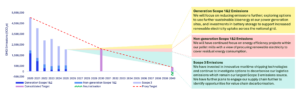
We recognise that clearly defined actions to achieve carbon reduction targets are central to credible transition planning. The diagram below provides an overview of current projects and several projects in development, as we continue to progress the carbon reduction plans for each of our business units. In 2024, we built on this with the publication of a formal Climate Transition Plan, in line with the Transition Plan Taskforce (TPT) Disclosure Framework.
Framework in focus
We’ve already taken one big step towards helping to tackle the challenge of climate change, having converted Drax Power Station from coal to sustainable biomass. But we recognise there is still much to do.
Our objective isn’t just to reduce emissions, but to have a net positive impact on the climate. We’ll aim to do this through the eight targets outlined in the Climate Positive section of our Sustainability Framework.
Target
Achieve our near-term 2030 SBTi targets and aim to further achieve our 2040 net zero target
Progress
With advancements in action as well as governance we continue to make progress against our target to achieve our near-term 2030 science-based target and reach net zero by 2040.
We entered the process of validating our net zero science based target with SBTi in 2025, achieving validation in early 2026, showing our ongoing commitment to reach net zero by 2040. We also invested in decarbonisation projects to support progress against our targets. Our net zero target commits us to reduce emissions in line with the SBTi stated reductions and neutralise any residual emissions using permanent carbon removals. The validated targets and progress against the near-term targets are shown in our Annual Report.
We developed a forest carbon appraisal methodology, including futures scenario modelling, and shared it with industry stakeholders at international conferences such as the European Biomass Conference and Exhibition 2025. This completed the proposed goal of this target. Another component of the methodology includes the use of remote sensing for monitoring forest carbon stocks in our catchment areas, among other metrics. We developed the remote sensing tool in collaboration with Google and NGIS to enable us to track fibre sourcing to individual parcels of land and increase the effectiveness of our forest sourcing tracking. The remote sensing tool also enables us to visualise and analyse changes in the forest carbon stocks over time and support us in upholding our sustainable sourcing commitments. In 2026, following the publication of the GHG Protocol’s Land Sector and Removals Guidance, we will utilise the data to undertake a detailed analysis of the carbon stock changes within our sourcing areas.
Working in conjunction with external consultants, we are in the process of developing climate change adaptation and mitigations plans for all our sites in the UK. We have already delivered three completed plans, identifying climate physical risks across 216 metrics. This has enabled us to better manage and understand climate risks and propose changes to our assets to reduce the likelihood of hazardous events causing an impact at our sites. This enables site and financial security in our operations, and has supported our TCFD assessments to understand the financial impacts associated with climate change at our sites.


Page updated June 2026